🇱🇺 Portrait of a European — Luxembourg
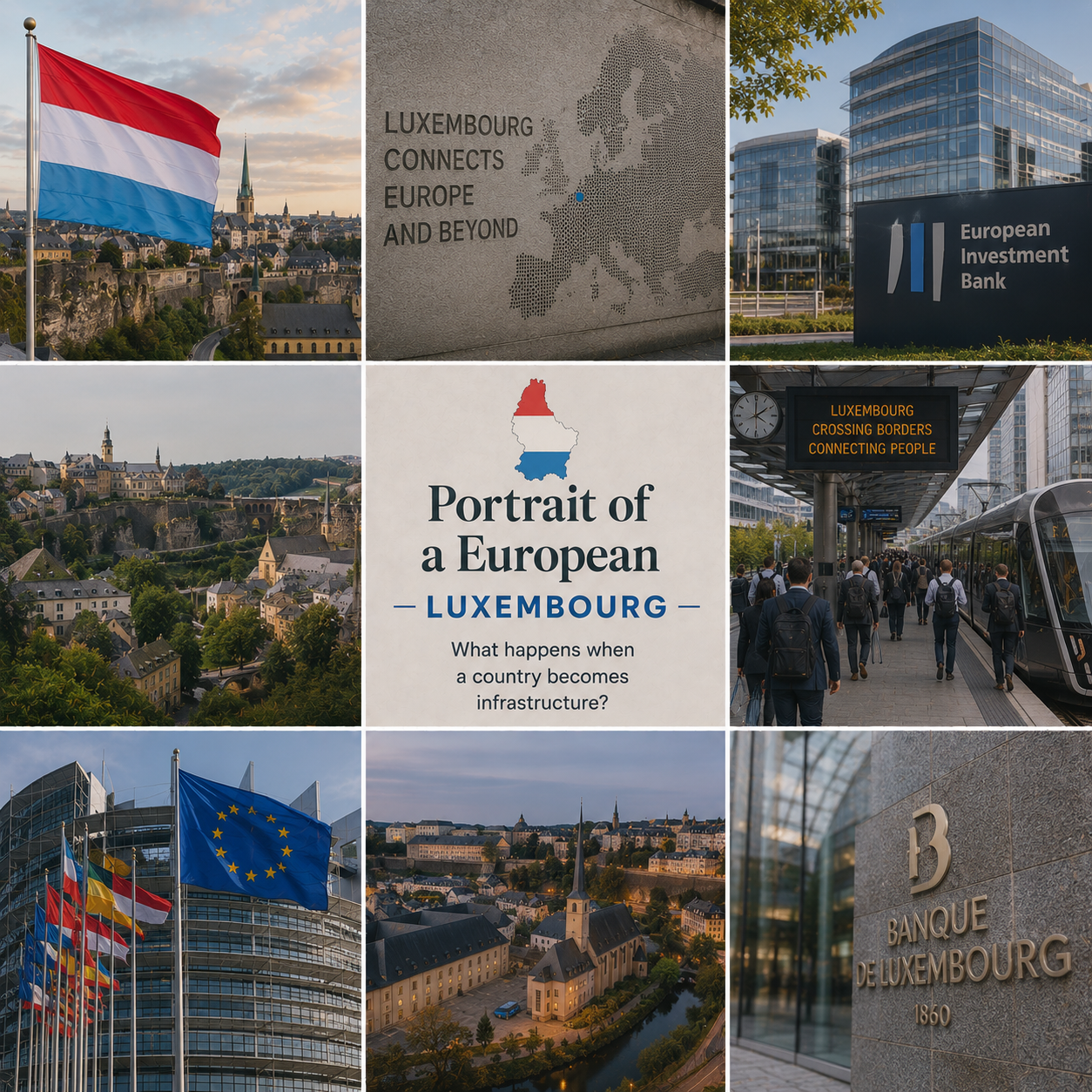
What happens when a country becomes infrastructure?
🇱🇺 Snapshot
- Capital: Luxembourg City
- Population: ~680,000
- Economy: finance, European institutions, logistics and international services
- Position: highly interconnected microstate functioning as a financial and administrative hub inside Europe
Luxembourg often feels less like a traditional nation-state and more like a system node. Small geographically. But structurally enormous.
The country became:
- a financial hub,
- a European administrative centre,
- a logistics connector,
- and a crossroads of international labour flows.
In many ways, Luxembourg functions almost like Europe in concentrated form: multinational, networked, mobile, institutional and deeply interconnected.
👤 The average Luxembourger
Daily life in Luxembourg is highly international.
Large parts of the workforce commute daily from:
- Belgium,
- France,
- and Germany.
Many workplaces operate across:
- multiple languages,
- international legal systems,
- and transnational financial structures simultaneously.
Common professions:
- banking and finance
- European administration
- legal and compliance services
- logistics and technology
The country often feels less nationally isolated than structurally connected to surrounding Europe.
🧬 Demography & society
Luxembourg has one of Europe’s most international populations. A significant share of residents were born abroad.
Multiple languages coexist naturally:
- Luxembourgish,
- French,
- German,
- and English in international business environments.
This creates a society where identity feels layered and fluid rather than singular.
At the same time, Luxembourg remains socially cohesive through:
- strong institutions,
- economic stability,
- and pragmatic governance.
The country demonstrates that diversity can become structurally normalised when supported by functioning systems.
🧠 Self-image
The Luxembourgish self-image is often understated.
Unlike larger states, Luxembourg rarely defines itself through:
- military power,
- strong nationalism,
- or geopolitical projection.
Instead, the country sees itself through:
- stability,
- reliability,
- connectivity,
- and institutional competence.
Luxembourg understands its value not through scale, but through function. It became important because it enables systems larger than itself to operate smoothly.
🇪🇺 Relationship with Europe
Luxembourg is deeply embedded inside the European project. European institutions are not abstract here. They are physically present in everyday life.
The country hosts:
- EU institutions,
- financial coordination,
- regulatory infrastructure,
- and major cross-border administrative systems.
In some ways, Luxembourg represents Europe’s infrastructural logic more clearly than almost any other country.
Because its prosperity depends almost entirely on interconnected networks:
- finance,
- mobility,
- administration,
- trade,
- and legal harmonisation.
⚖️ Tension
This is where Luxembourg becomes especially revealing.
It balances between:
- national sovereignty and supranational integration
- local identity and internationalisation
- financial openness and political scrutiny
The country’s financial role generated criticism around:
- tax structures,
- multinational capital,
- and European economic imbalance.
Yet Luxembourg also reveals something uncomfortable about modern Europe: Many European systems rely on highly concentrated infrastructural hubs that remain mostly invisible politically. Without countries like Luxembourg, large parts of Europe’s financial and administrative coordination would function far less efficiently.
🏡 Everyday life
Life feels organised, international and mobile.
In Luxembourg City:
- financial districts,
- multilingual workplaces,
- European institutions,
- and constant commuter flows shape daily reality.
Outside urban centres:
- quieter villages,
- high quality of life,
- and strong local continuity remain visible.
Luxembourg therefore feels simultaneously: global and highly local.
✨ What makes Luxembourg unique
Luxembourg may be one of Europe’s clearest examples of a “network state”.
Its importance comes not from:
- territory,
- population,
- or military scale.
But from:
- connectivity,
- trust,
- financial coordination,
- and institutional infrastructure.
The country demonstrates that in modern Europe, power increasingly flows through systems rather than size alone. Luxembourg therefore functions almost like invisible architecture: quiet, stable and essential.
🪞 Closing
This is a portrait of a European. Not shaped by scale. But by connectivity. Not defined by visibility. But by enabling larger systems to function.
This is what Europe looks like—when a country becomes infrastructure itself.
This article is part of Portrait of a European — a series exploring how people across Europe see themselves through work, identity and everyday life. Each edition offers a local perspective on a shared continent.
📷 Caption
A glimpse of everyday life in Luxembourg—where finance, European governance and cross-border mobility converge inside one of Europe’s most interconnected and strategically networked societies.
✍️ Credit
Altair Media — Portrait of a European series
