The Quantum Generation: Who Will Build Europe’s Technological Future?
Beyond the laboratory, towards a quantum-ready society
Europe is investing in quantum computers, research infrastructure and industrial capacity. But who will develop, operate, maintain and ultimately use these technologies? The quantum revolution is often presented as a scientific and technological challenge. It is also an educational, economic and societal transformation.
Europe is expanding its specialised quantum education programmes. Yet the challenge extends far beyond universities and the training of scientific researchers.
An emerging quantum economy will require engineers, technicians, entrepreneurs and citizens capable of understanding a technology whose future applications are still being discovered.
Five questions expose the human dimension of the quantum revolution.
🟦 1 | Does Europe need more physicists — or a different kind of workforce?
Quantum technology has its foundations in physics and mathematics. Its industrial development, however, requires a much broader range of capabilities.
A joint OECD and European Patent Office study, published in December 2025, reveals the scientific character of today’s global quantum labour market.
Computer science and IT accounted for approximately 26% of quantum-related job postings, while science and research represented around 25%. Education and training accounted for 10%, whereas commercialisation-oriented occupations represented less than 10%.
As the industry develops, engineers, laboratory technicians, software developers, cybersecurity specialists and commercial professionals could become increasingly important.
Not everyone working in quantum technology will need to be a quantum physicist.
The tension: Europe is educating people to advance the science. Is it also educating people to build an industry?
🟦 2 | What should the next generation actually study?
For young people considering their future careers, quantum technology presents an unusual dilemma.
Should they specialise early in quantum physics, or develop broader capabilities in engineering, computer science, mathematics and electronics?
The answer will depend on the role they eventually pursue.
Quantum research requires highly specialised scientific knowledge. Industrial applications may require professionals capable of combining existing technical disciplines with an understanding of quantum systems.
In June 2026, the European Commission launched its Quantum Digital Skills Academy, intended to strengthen access to education and training across Europe.
But educational institutions must prepare students for a labour market that is itself still taking shape.
The tension: young people must make educational choices today for professions that may not yet exist tomorrow.
🟦 3 | Can the existing workforce become quantum-ready?
Europe’s future quantum workforce will not emerge exclusively from its universities.
Electronics engineers, semiconductor technicians, cryogenics and photonics specialists, cybersecurity professionals and software developers already possess capabilities that could become increasingly relevant to quantum applications.
Vocational education, professional training and lifelong learning may therefore become just as important as specialised academic programmes.
For established businesses, the challenge will be identifying which employees need advanced technical knowledge and which require a practical understanding of emerging applications.
A quantum-ready workforce does not necessarily mean a workforce of quantum experts.
The tension: technological innovation can move faster than educational systems, while existing workers must adapt without knowing precisely which skills will become most valuable.
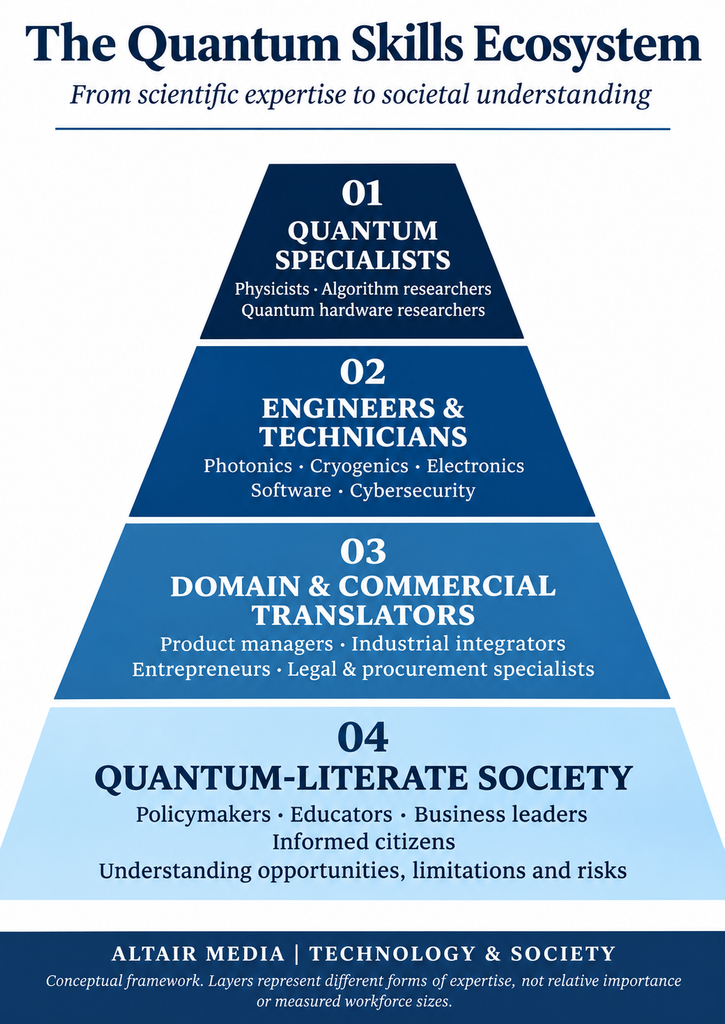
Source: Altair Media — Conceptual framework.
Caption: The Quantum Skills Ecosystem: different levels of knowledge and professional expertise are needed to connect scientific innovation with industrial applications and societal understanding.
🟦 4 | Can Europe retain the talent it educates?
European universities attract and educate highly specialised researchers. But scientific excellence does not automatically guarantee attractive industrial career opportunities.
Researchers and engineers make career decisions based on salaries, research facilities, professional opportunities and personal circumstances.
The strategic challenge extends beyond geographical mobility. European researchers can remain in Europe while contributing to intellectual property and technological capabilities controlled by non-European companies.
International investment and scientific collaboration can strengthen European research ecosystems. Yet the location of talent does not necessarily determine where economic value and strategic control ultimately reside.
The tension: Europe benefits from the international circulation of scientific knowledge, but must also ensure that its educational investments contribute to its own long-term industrial capabilities.
🟦 5 | Could quantum create a new societal knowledge divide?
Artificial intelligence has already demonstrated how quickly emerging technologies can expose differences in digital literacy.
Quantum technology could introduce another dimension.
Most citizens will never need to understand quantum algorithms or operate a quantum computer. But business leaders, policymakers, educators and citizens may increasingly need to understand the capabilities, limitations and societal implications of quantum technologies.
This becomes particularly relevant when technological developments affect digital security, privacy, healthcare and economic opportunities.
Who will be equipped to assess their benefits, risks and consequences?
And who will simply experience the outcomes of decisions made by others?
Technological literacy should not become an exclusive privilege of highly specialised professionals.
The tension: quantum technology could contribute to societal progress while simultaneously widening the knowledge gap between those who understand it and those who depend on it.
🟦 THE SIGNAL
Europe’s quantum future will require more than scientific excellence and specialised talent. It will require educational pathways connecting universities, vocational institutions, industrial employers and society.
Not everyone needs to become a quantum scientist. But more people will need the knowledge to participate in a society increasingly shaped by quantum technologies.
The quantum revolution must not only be built by people. It must also be understood by them.
This article is part of Altair Media’s Quantum Series, exploring the scientific, industrial, economic and societal dimensions of Europe’s emerging quantum ecosystem.
Credit
Illustration: Altair Media / OpenAI (AI-generated editorial watercolour).
Caption
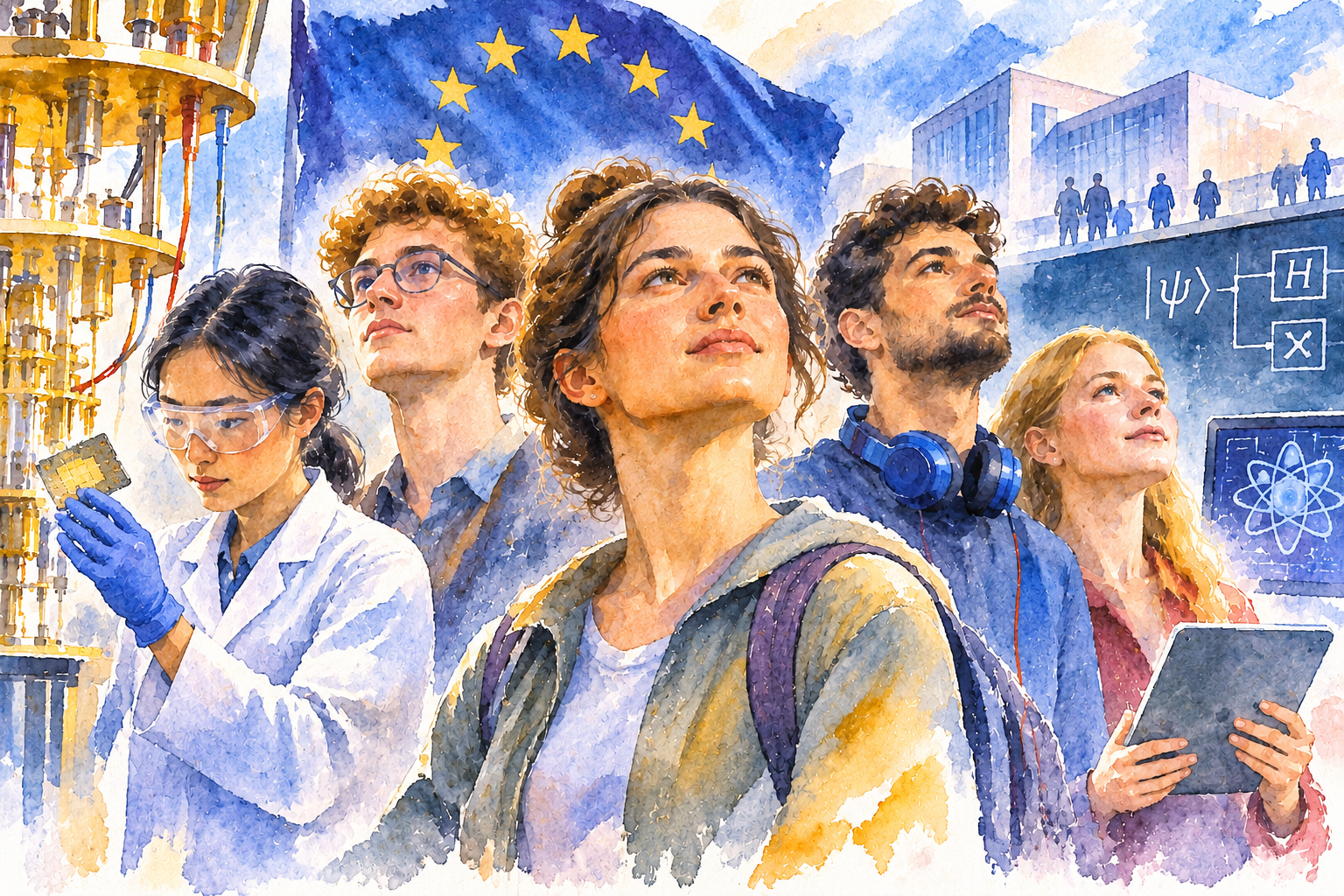
The Quantum Generation. An editorial watercolour representing the people behind Europe’s emerging quantum ecosystem. From scientific researchers and technical specialists to students and future professionals, their knowledge, skills and ambitions will help shape the technological transformation ahead.
Conceptual illustration of Europe’s next generation of quantum talent and the transition towards a quantum-ready society.
