Europe’s Tech Boom Has an Ownership Problem
Europe can build technology champions. Can it retain their value?
European technology investment is forecast to reach $81 billion in 2026, while the continent produces an estimated 40,000 new founders. Both are signs of renewed momentum. Yet Atomico’s latest State of European Tech report also exposes an uneven financing market, limited AI computing capacity and a question that reaches beyond venture capital: who ultimately benefits when European innovation succeeds?
Europe’s technology industry is entering a new phase of expansion. Investment is recovering, company valuations are rising and increasingly ambitious businesses are attracting billion-dollar financing rounds. After several difficult years, confidence appears to be returning to the European technology ecosystem.
But the headline figures tell only part of the story. The deeper question is no longer simply whether Europe can produce globally competitive technology companies. It is whether the continent has developed the financial, industrial and institutional structures needed to support their growth and retain the benefits of their success.
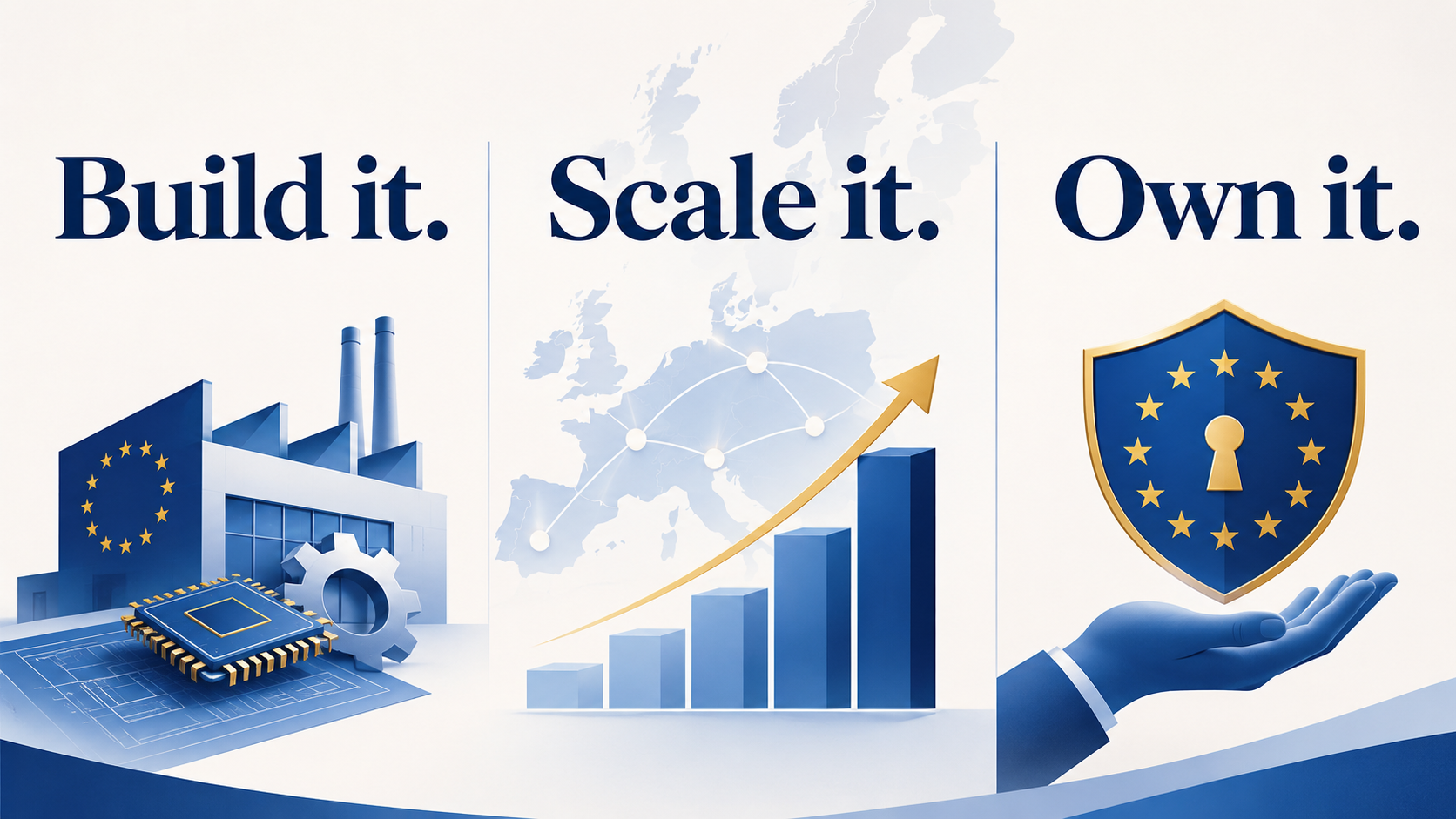
Published on 18 November, Atomico’s State of European Tech 2026 carries the theme Build it. Scale it. Own it. Its findings offer a revealing starting point for examining five structural tensions shaping Europe’s technological future.
🟦 Is Europe’s technology revival as strong as the headline suggests?
An expected $81 billion in investment would make 2026 the second-strongest year on record for European technology financing, behind the exceptional peak of $94 billion in 2021. Compared with the $50 billion invested in 2025, the projected increase of 62% represents a substantial recovery in investor confidence.
Yet the distribution of that investment raises questions about the breadth of the revival. During the first nine months of 2026, just 13 financing rounds of at least $1 billion accounted for approximately $22 billion, or 37% of all capital invested during that period. Companies such as Mistral AI and Nscale illustrate Europe’s growing ability to attract exceptionally large financial commitments.
These investments demonstrate that European businesses can compete for substantial amounts of capital. They also reveal a market increasingly concentrated around a relatively small number of ambitious companies, particularly in artificial intelligence and associated infrastructure.
Such concentration is not necessarily unhealthy. Building advanced AI systems, semiconductor technologies or large-scale industrial infrastructure requires considerably more capital than developing conventional software applications. Nevertheless, aggregate investment growth should not be confused with broader access to financing. A venture capital market can recover spectacularly at the top while remaining difficult for thousands of smaller companies.
The tension: Europe is attracting more investment, but its technology recovery remains unevenly distributed.
🟦 Why are more Europeans starting technology companies while early-stage financing is shrinking?
One of Atomico’s most striking findings concerns entrepreneurship itself.
An estimated 40,000 people will have founded technology companies in Europe during 2026, an increase of 36% compared with 2025. Europe now accounts for approximately 29% of new technology founders worldwide, narrowly ahead of the United States, according to the report’s dataset.
This development challenges the familiar narrative that Europe lacks entrepreneurial ambition. A new generation of founders is emerging across the continent, supported by an increasingly mature startup ecosystem and technologies that reduce the cost of developing new products.
Artificial intelligence is accelerating this process. Smaller teams can undertake activities that previously required substantially greater financial resources, making it easier to experiment with new business models and technological applications.
However, another indicator points in the opposite direction. The number of European pre-Series A financing rounds — often described as first-money-in investments — declined by almost 30% between 2021 and 2025. That comparison covers completed years, whereas the report’s 2026 founder figures are estimates.
The indicators measure different things, but their divergence is significant. It suggests that Europe’s entrepreneurial pipeline is expanding while opportunities to secure early institutional financing have become more constrained.
Investor selectivity is not inherently negative. Not every startup requires venture capital, and not every new company has the potential to become a high-growth business. Nevertheless, a persistent shortage of early-stage risk capital may prevent promising technologies from advancing beyond initial development.
Europe’s challenge is therefore not simply to encourage more people to establish companies. It is to ensure that viable businesses have credible routes from experimentation to commercialisation.
The tension: Europe is generating more entrepreneurs without creating equally strong financing opportunities for the companies they establish.
🟦 Can Europe become technologically sovereign without controlling its computing infrastructure?
Europe’s growing AI ambitions expose an even more fundamental structural weakness.
According to Atomico, approximately $20 billion flowed into European AI and computing companies during the first nine months of 2026, more than double the previous year’s comparable investment level. In the United States, investment in the same sectors reached approximately $284 billion during that period — more than fourteen times the European figure.
The difference extends beyond investment flows. Europe accounts for approximately 7% of global AI computing capacity, compared with 72% in the United States, according to the report.
These figures matter because advanced artificial intelligence increasingly depends on specialised processors, data centres, energy infrastructure and sustained access to large-scale capital. Technological competitiveness is becoming inseparable from the physical and financial infrastructure required to develop and deploy AI systems.
Europe has demonstrated its capacity to develop competitive AI technologies. Companies such as Mistral AI are building advanced models, while new infrastructure initiatives seek to expand domestic computing resources.
The European Commission’s AI gigafactory ambitions reflect a growing recognition that computing capacity is becoming an industrial and strategic resource. Yet constructing additional facilities does not automatically eliminate dependency. Their operation may still rely on foreign semiconductor suppliers, cloud platforms and specialised technologies.
Moreover, technological sovereignty does not necessarily require domestic ownership of every component. Reliable international partnerships, diversified suppliers and credible alternatives may provide greater resilience than an unrealistic ambition of complete technological self-sufficiency.
The strategic issue is whether Europe retains sufficient control over the infrastructure required to develop, commercialise and deploy its most important technologies.
The tension: Europe can produce internationally competitive AI companies while remaining dependent on computing infrastructure and technologies controlled elsewhere.
🟦 Why does Europe’s enormous pool of savings remain disconnected from its technology ambitions?
The financing challenge becomes particularly striking when Europe’s institutional wealth is considered.
Atomico identifies approximately $13 trillion in European pension fund assets, against annual commitments of around $780 million to European venture capital funds. That annual flow represents approximately 0.006% of the underlying pension asset base, compared with around 0.028% in the United States.
These percentages are small, but the underlying financial resources are enormous. Even modest changes in institutional investment strategies could significantly affect the capacity of European venture capital markets.
However, the problem cannot be reduced to convincing pension funds to invest more aggressively. Pension institutions have long-term obligations to their beneficiaries, and their investment decisions must reflect risk, liquidity, diversification, regulatory requirements and expected returns. Venture capital is inherently uncertain, particularly when investments involve young companies developing technologies without established commercial markets.
The European Central Bank has nevertheless identified the narrow institutional investor base as one of the structural weaknesses of Europe’s venture capital ecosystem. Its research highlights a significant gap in later-stage financing, when innovative businesses require increasingly large investment rounds to expand internationally.
This is where the European debate about capital market integration becomes directly relevant to industrial competitiveness.
The ECB estimates that venture capital funds located in the United States hold approximately €930 billion, compared with around €150 billion in the European Union. The imbalance reflects not only different volumes of available capital, but also differences in institutional participation, fund size and the maturity of investment markets.
More venture capital alone will not solve the problem. Europe also needs functioning exit markets, institutional investment expertise and attractive opportunities for investors seeking commercially sustainable returns. Public institutions can help address particular financing gaps, but they cannot indefinitely substitute for sufficiently deep private capital markets.
The tension: Europe possesses substantial long-term financial resources, but its investment structures remain poorly connected to the financing needs of high-growth technology companies.
🟦 Who ultimately owns Europe’s technological success?
The final question reaches beyond the availability of capital.
European technology companies increasingly operate in international financial markets. Foreign investors can provide essential funding, commercial expertise and access to global networks. Their participation is often indispensable to successful international expansion.
The strategic concern is therefore not foreign ownership itself. It is what happens when European companies become so dependent on external financing that strategic decisions, intellectual property, corporate headquarters or future financial returns increasingly migrate elsewhere.
The European Central Bank has highlighted precisely this vulnerability. Its research identifies foreign acquisitions, overseas listings and the potential relocation of corporate functions as consequences associated with Europe’s limited domestic scale-up financing capacity.
This does not mean that every internationally financed European company represents a loss to Europe. A business can attract American capital while maintaining European research facilities, employment, management and substantial economic activity. Ownership, control and economic benefit are related, but they are not identical.
The policy challenge is to create conditions in which successful companies have a genuine choice to remain and expand within Europe.
The proposed EU Inc corporate framework could contribute to that ambition by simplifying cross-border company formation and operations. On 23 October 2026, the Council of the European Union adopted its negotiating position on the proposed framework, although the legislation has not yet been finalised.
Legal simplification addresses only one dimension of the problem. Companies also require access to customers, competitive energy prices, specialised skills, capital markets and public procurement opportunities capable of supporting commercial growth.
Indeed, public procurement could become an important strategic instrument. Government contracts can provide emerging technology companies with the initial commercial demand, reference customers and predictable revenue needed to attract additional private investment.
Europe’s ambitions will ultimately be judged not simply by the number of startups it creates or the valuations they achieve, but by the extent to which those companies contribute to durable European economic capacity.
The tension: Europe must remain open to international investment while strengthening its ability to retain the strategic and economic benefits of innovation.
The Altair Signal
Atomico’s State of European Tech 2026 provides convincing evidence that Europe’s technology ecosystem is becoming more ambitious and capable. The recovery in investment, growing number of founders and emergence of internationally competitive companies deserve recognition.
But the findings also expose a structural contradiction. Europe is increasingly successful at creating technological opportunities without having developed an equally powerful system for financing, scaling and capturing their long-term economic value.
The next stage of European technology policy must therefore connect three ambitions that are too often treated separately: financial market development, industrial capacity and technological resilience. Deeper capital markets, more effective public procurement and initiatives such as EU Inc will only fulfil their potential if they help companies move from promising technologies to sustainable commercial scale.
The test for 2027 will be whether Europe can turn these ambitions into practical results: mobilising institutional capital, creating meaningful demand through public and private contracts, and offering its emerging AI and infrastructure companies credible alternatives to seeking their next stage of growth predominantly outside Europe.
The goal should not be to isolate European businesses from international competition or capital. It should be to ensure that successful European innovation translates into sustained economic activity, investment opportunities and strategic capabilities within Europe.
Europe has demonstrated that it can build technology companies. Its next challenge is to ensure that it can finance their growth — and retain a meaningful share of the value they create.
Sources and research context
- Atomico — State of European Tech 2026, published 18 November 2026. Investment totals for 2026 are projections; early-stage financing trends refer to the 2021–2025 period.
- European Central Bank — Europe’s venture capital gap and the financing of high-growth firms, Economic Bulletin 5/2026.
- European Central Bank — Exploring the investor landscape for venture capital, Financial Integration and Structure in the Euro Area 2026.
- Council of the European Union — EU Inc negotiating position, 23 October 2026.
Editorial context: Atomico is an active European venture capital investor. Its findings provide important market evidence, while its policy recommendations also reflect the perspective and interests of the venture capital industry.
Image credit
Illustration: Altair Media / AI-generated artwork. Inspired by the theme “Build it. Scale it. Own it.” from Atomico’s State of European Tech 2026.
Image caption
Build it. Scale it. Own it. Europe’s technology challenge extends beyond innovation: turning promising companies into global competitors while retaining control over the infrastructure, capital and economic value that underpin their success.
