Europe Has More Stories to Tell
After seventeen years away from writing, returning has become an exercise in discovery. That curiosity is shaping Altair Media, its approach to experimental writing and a new European briefing.
When I started writing again last year, after seventeen years away, I expected to find a different media landscape. What I had not expected was how much there would be to discover about Europe.
The more I explored, the more connections appeared. Between culture and entrepreneurship. Between scientific research and industrial ambition. Between the savings people accumulate and the companies that struggle to finance their next step. Between countries whose futures are more closely connected than their national debates often suggest.
What surprised me most was something quite simple: Europe has a compelling story to tell. Much of it is still waiting to be explored. That discovery is becoming the editorial foundation of Altair Media.
Writing to Discover
Political debate matters. Decisions about public spending, migration, security and democratic accountability deserve scrutiny. But I want Altair Media to make room for the Europe that is less visible in the daily contest between political positions: the people building things, preserving knowledge, creating culture and finding ways to work together.
A workshop, an exhibition or a regional food market can reveal something about Europe that a summit cannot. So can a research laboratory or a company trying to turn a scientific breakthrough into a viable business. These stories help us understand what people value, what they know how to make, and what they hope to pass on.
For me, experimental writing means giving that curiosity room to work. It means following a question across the boundaries that usually separate subjects and allowing what I find to change the direction of a piece. A story about photonics can become a story about industrial independence. A story about fruit can open a discussion about water, labour, logistics and the future of a region.
The experiment lies in the questions, the connections and the form. The facts still need checking. An interpretation should be recognisable as an interpretation and a promising idea should remain open to challenge.
Europe in Motion
There is also a wider European question running through this work. The EU’s 27 member states have distinct histories, interests, rights and obligations. Those differences deserve respect. Their interdependence deserves equal attention.
Seen from that perspective, I find Ursula von der Leyen’s ambition to make Europe more capable of acting understandable. Shared challenges require decisions that countries can carry out together. The difficult task is to make that cooperation effective while keeping authority accountable and national differences meaningful.
Finance offers a particularly revealing example. The euro and the European Central Bank established a shared monetary framework for the countries participating in the currency union. A further challenge is to make capital move more effectively between European savings, businesses and long-term investment needs. That is the purpose of the Savings and Investments Union: improving opportunities for savers while helping companies obtain the finance they need to grow.
This involves institutions with different responsibilities. The European Banking Authority works on common banking rules. The Single Resolution Board prepares for and manages the orderly resolution of failing banks within its remit. The new Anti-Money Laundering Authority, AMLA, is building a more consistent European approach to fighting illicit finance. I see these as different parts of the institutional foundations on which a more connected financial system depends.
ESMA, the European Securities and Markets Authority, could become an increasingly important point of connection in that system. On 9 October, the Council agreed key elements of a negotiating position that would transfer supervision of significant cross-border trading venues and certain market infrastructures to ESMA. The legislation still requires agreement. Euronext itself has argued for integrated European supervision. The direction is worth following: markets that operate across borders need a framework capable of doing the same.
What interests me is where that financial architecture meets something tangible: a factory, a new technology, an electricity connection or a growing business.
Energy brings those connections into focus. Europe must renew infrastructure that already serves its households and industries, while adapting it to electrification and new sources of demand. AI and data centres add to that challenge. Generating more electricity, modernising grids, improving efficiency and developing storage are closely related tasks.
The scale is considerable. The European Commission estimates that energy investment needs to reach around €660 billion annually in 2026–2030 and €695 billion annually in 2031–2040. Adding those annual estimates gives approximately €10.25 trillion over fifteen years. This is an estimated investment requirement across the economy, rather than a single EU spending commitment.
Behind that figure are practical choices about technology, financing and risk. Established energy companies, grid operators and new ventures all have roles to play. The European Investment Bank can help finance infrastructure and innovation. The European Investment Fund supports access to finance through investment funds and guarantees, including instruments for energy efficiency. Public finance can help bring private investors into projects that need patient capital.
The European Innovation Council connects to another part of this challenge: helping scientific and technological breakthroughs develop into businesses. Michiel Scheffer, President of the EIC Board, is one of the people working at that intersection of innovation, entrepreneurship and European ambition. In June, the Board highlighted nearly 100 EIC-backed companies developing technologies across twelve areas of the energy value chain, and called for faster deployment.
That is a story I want to understand better. How does a technology leave the laboratory? Who is prepared to finance it? Who becomes its first customer? And what does Europe need to do for that company to grow here?
The same curiosity can take us to the Baltic states. Lithuania’s laser and photonics industry, for example, offers a way to explore how specialist knowledge can give a relatively small country an international industrial role. It can also take us to the European fruit market, where questions about production and trade quickly become questions about landscapes and livelihoods. Or to Switzerland’s project to host the 2038 Winter Olympics and Paralympics, which remains a candidacy under discussion and raises questions about infrastructure, community and the future of winter sport.
Europe extends beyond the EU’s institutional borders. Its stories connect places, skills and ambitions in ways that deserve a closer look.
An Open Invitation
There are encouraging signs that readers share this curiosity. Between 1 January and 18 October 2026, my LinkedIn posts generated more than 1.3 million impressions and reached almost 400,000 members: 1,341,091 impressions and 388,815 members, according to LinkedIn’s analytics. These figures describe the reach of my posts on that platform. For Altair Media, they are an encouraging reason to keep developing the work.
The next step is the Altair Media Experimental Briefing.
It will bring together selected European stories and explain why they deserve attention. Photonics and capital markets will sit alongside the fruit trade, cultural developments, energy innovation and the Swiss Olympic project. The selection will follow the questions emerging from the work, with room for subjects that do not usually appear together in a briefing.
The briefing will initially be free. Once registrations exceed 1,000, readers will receive a subscription offer, with the terms set out before they decide whether to join.
I returned to writing with plenty to learn. A year later, that remains one of its greatest attractions. Through Altair Media, I want to keep exploring Europe and invite readers to discover more of it with me.
Join the Altair Media Experimental Briefing using the form below.
Credit
AI-generated illustration created with ChatGPT / OpenAI for Altair Media.
Caption
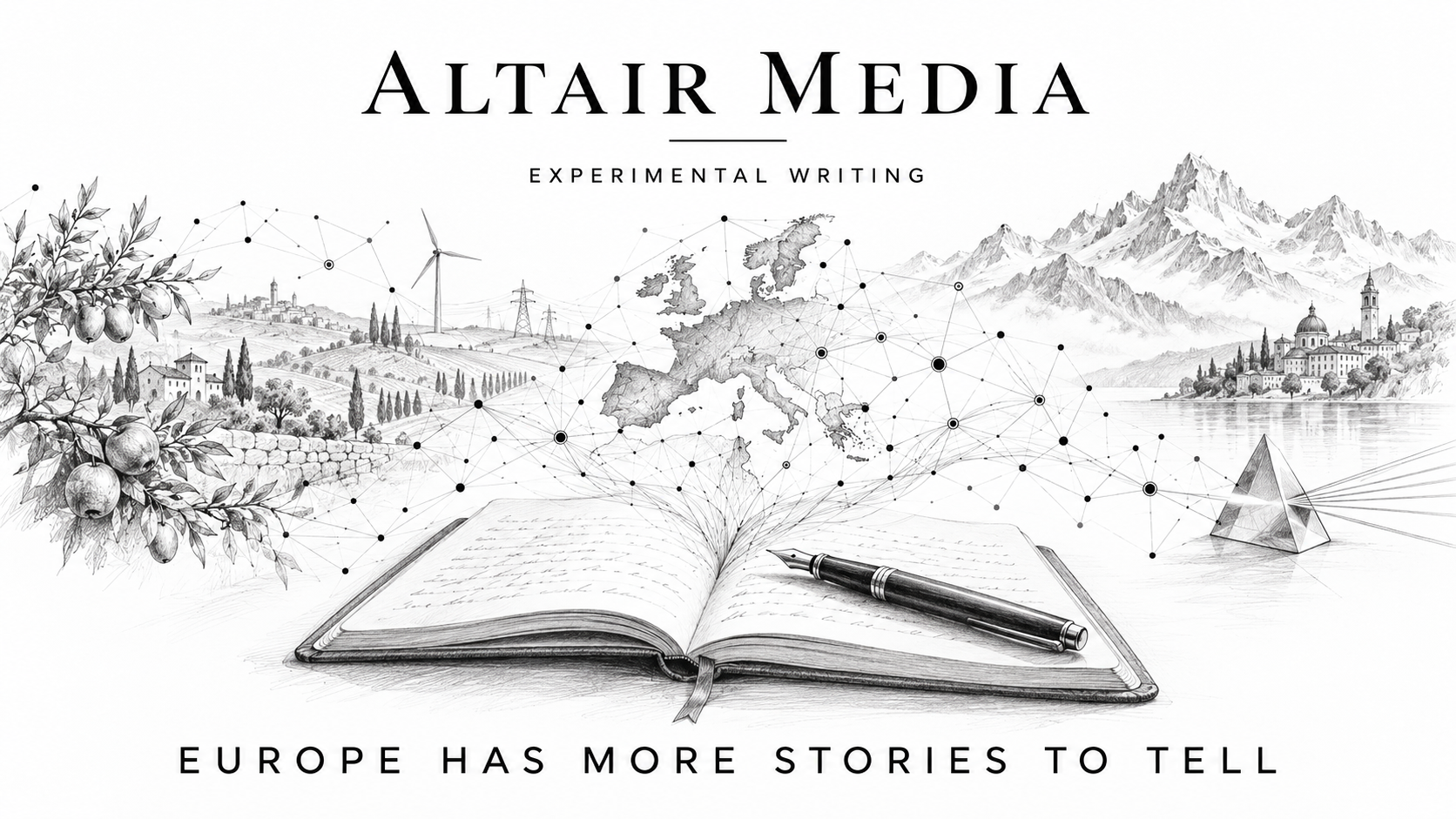
An open notebook connects Europe’s landscapes, technologies and ideas, reflecting Altair Media’s approach to experimental writing: following curiosity to discover how European stories connect.
