Beyond High NA
Why the public debate between ASML and TSMC reveals a broader shift in semiconductor strategy
Strategic Briefings
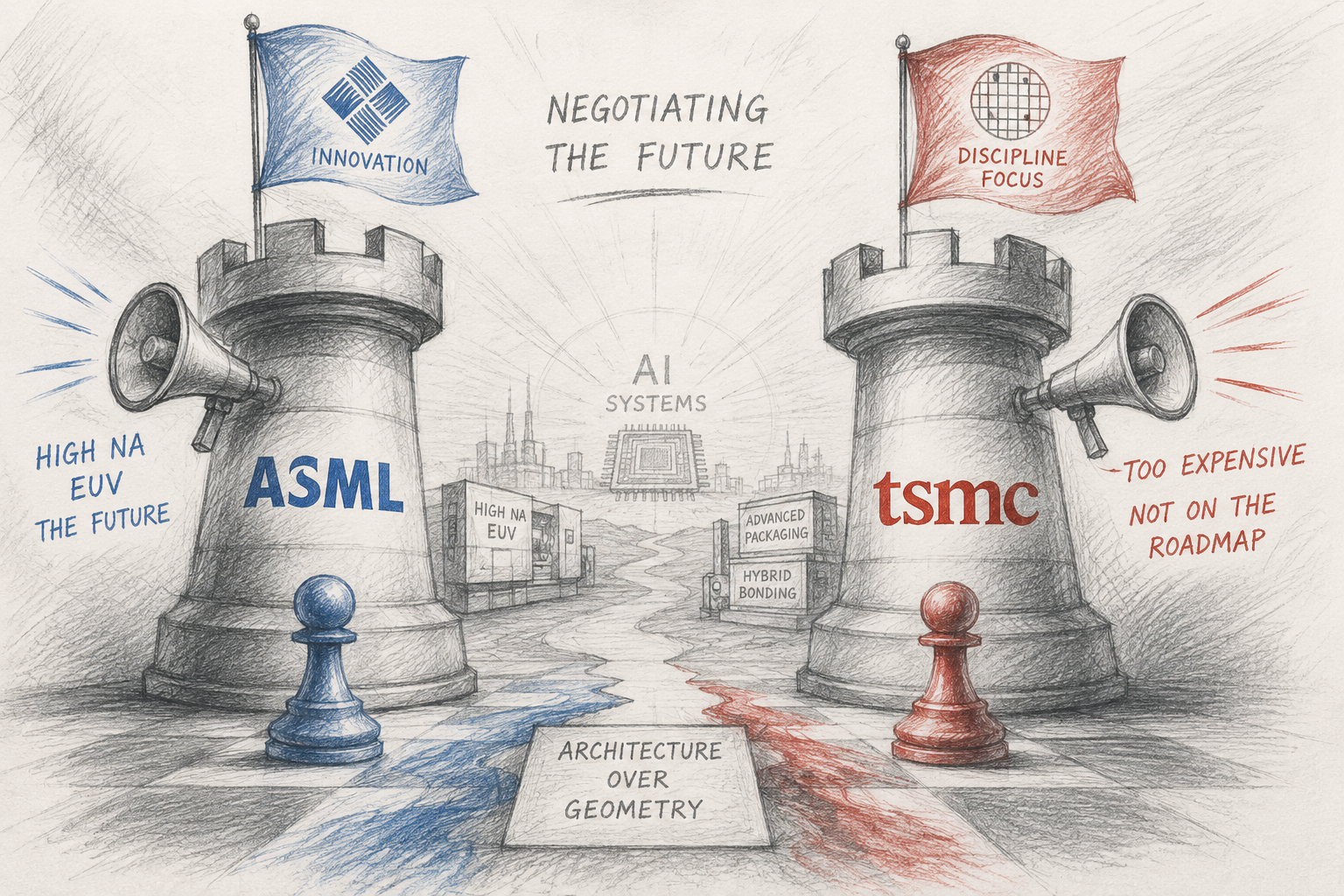
At first glance, the latest exchange between ASML and TSMC appears to be a familiar commercial disagreement. TSMC has indicated that it does not yet see a compelling business case for adopting ASML’s High NA EUV lithography systems, citing their considerable cost. ASML, meanwhile, has highlighted Intel’s commitment to High NA as evidence that the technology already has an important place in the industry’s future.
What makes this episode remarkable is not the disagreement itself, but the fact that two of the world’s most influential semiconductor companies appear to be negotiating their positions largely in public.
Major decisions about next-generation manufacturing technology are normally discussed behind closed doors. By communicating through earnings presentations, interviews and press releases, both companies are also speaking to investors, governments, customers and competitors. The discussion therefore extends well beyond a single purchasing decision. It is shaping expectations about where the semiconductor industry is heading next.
Yet the most important story may lie beneath the debate over High NA itself.
From Geometry to Architecture
For decades, progress in semiconductors followed a relatively simple narrative. Smaller transistors delivered more powerful chips, and every new lithography generation represented another step along Moore’s Law. That model is becoming increasingly difficult to sustain. As transistor scaling approaches both physical and economic limits, while AI workloads demand ever-greater computing performance and energy efficiency, manufacturers are looking beyond geometry alone.
Increasingly, the challenge is no longer to build smaller chips, but to build better systems.
Technologies such as advanced packaging, chiplets and hybrid bonding allow manufacturers to combine specialised chips produced on different process nodes into a single high-performance package. Semiconductor performance is therefore becoming increasingly architectural rather than purely geometrical. Competitive advantage no longer depends solely on shrinking transistors measured in nanometres, but on coordinating how multiple technologies function together as one coherent system.
This broader transition also helps explain comments made by ASML CEO Christophe Fouquet during the company’s recent results presentation. While leading-edge production continues to expand, demand remains strong across multiple process nodes. Advanced AI accelerators require the most sophisticated manufacturing technologies, yet they also depend upon mature nodes supporting memory, networking, power management and numerous specialised components. Rather than advancing through a single technological frontier, semiconductor innovation is increasingly becoming the orchestration of an industrial ecosystem.
That evolution also changes how companies such as Besi and ASM International should be viewed. While ASML defines the precision with which transistors are manufactured, Besi’s hybrid bonding technology increasingly determines how those transistors are connected into larger computing systems. At the same time, ASM International’s deposition technologies enable the increasingly complex three-dimensional structures upon which future chip architectures depend. These technologies are complementary rather than competing.
This also helps explain TSMC’s current position. The discussion is not simply about the price of High NA equipment. TSMC has developed one of the world’s most advanced packaging ecosystems and may therefore possess greater flexibility in deciding when the next generation of lithography becomes economically attractive. The negotiation is therefore as much about timing and return on investment as it is about technology itself.
Europe’s Strategic Position
For Europe, this shift carries strategic significance.
Discussions about European semiconductor competitiveness often focus on attracting leading-edge fabrication plants. While manufacturing capacity remains strategically important, Europe’s greatest strength may lie elsewhere. Companies such as ASML, ASM International, Besi and Zeiss, together with research organisations such as imec, already occupy critical positions within the technologies that enable semiconductor manufacturing worldwide.
This suggests that Europe’s competitive advantage may not primarily depend on replicating TSMC’s manufacturing model, but on maintaining leadership in the enabling technologies that make global semiconductor production possible. As European industrial policy increasingly emphasises technological sovereignty and industrial resilience, strengthening this ecosystem may prove just as strategically important as attracting new fabrication facilities.
Whether TSMC adopts High NA sooner or later may ultimately prove less important than current headlines suggest. The larger transition appears to be from a semiconductor industry organised around individual process technologies towards one increasingly organised around system architecture, industrial coordination and ecosystem orchestration.
The public discussion between ASML and TSMC may therefore be remembered not as a disagreement over one generation of lithography equipment, but as an early signal that semiconductor leadership is becoming less about individual machines and increasingly about the orchestration of entire industrial ecosystems.
This Strategic Briefing was inspired by recent reporting and analysis from Bits&Chips, particularly the work of René Raaijmakers, whose observations on High NA EUV, hybrid bonding and semiconductor manufacturing strategies helped frame several of the broader strategic questions explored in this analysis.
Credit
Illustration: Altair Media (AI-assisted editorial artwork)
Caption
ASML and TSMC are publicly debating the future of semiconductor manufacturing. Behind the discussion over High NA lies a broader strategic transition—from shrinking transistors towards orchestrating integrated industrial ecosystems.
