The Country as Stadium
When Hosting Becomes a Model of Governance
The Olympic Operating System
Switzerland’s bid for the 2038 Winter Olympic Games proposes more than a sporting event. It raises a deeper question about governance itself: can an entire country become a platform for coordination, identity and collective ambition?
For more than a century, the Olympics have followed a familiar model. A city is selected, infrastructure is expanded, venues are built and the host temporarily becomes the symbolic centre of the world.
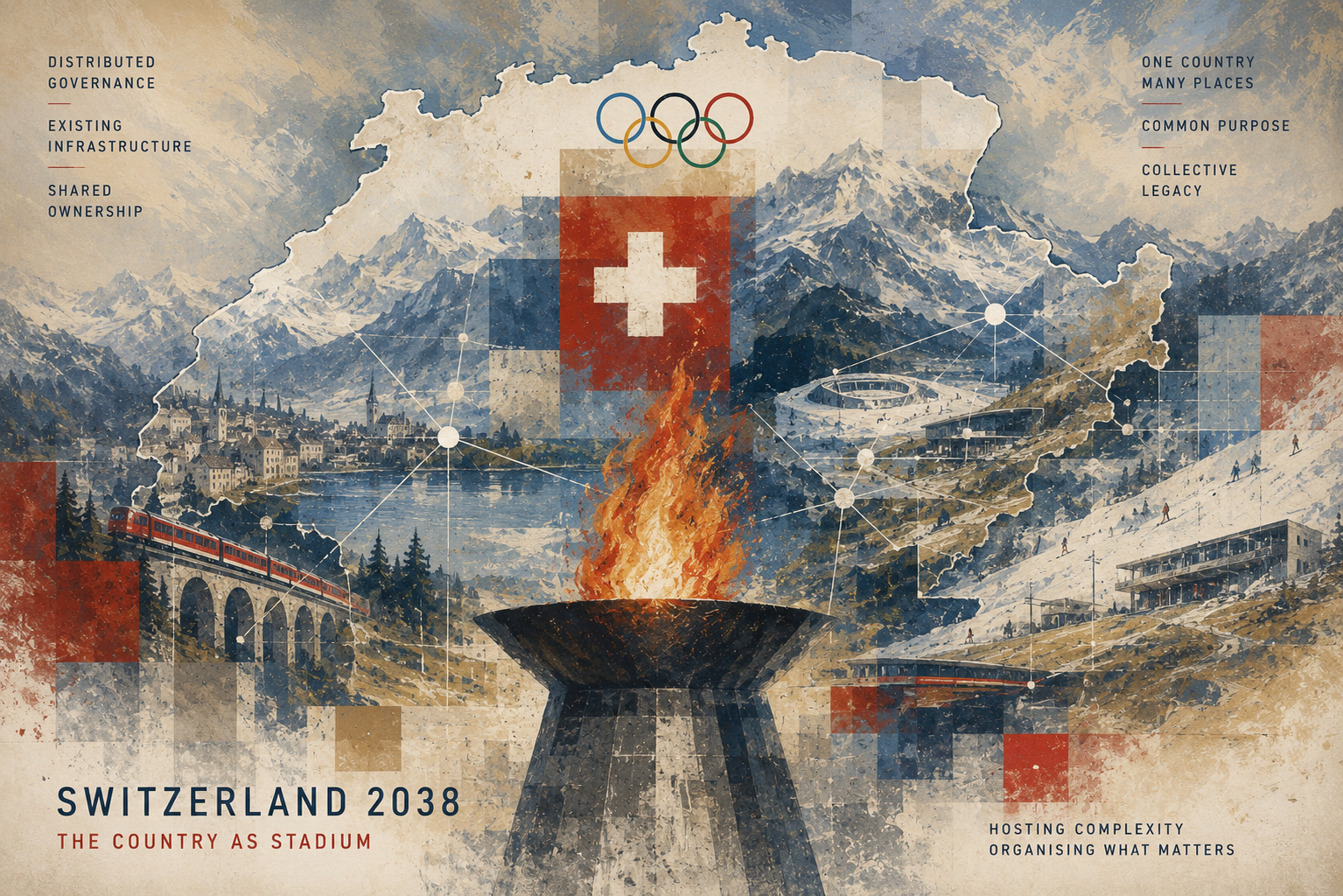
Switzerland suggests a different architecture. Not a city, but a country. Not concentration, but distribution. Not expansion, but coordination.
What appears to be a discussion about sport may in reality be an experiment in institutional design.
Can a decentralised society remain coherent under global scrutiny?
Switzerland has historically organised complexity differently from most nations. Political authority is dispersed, cantons maintain significant autonomy and infrastructure is distributed across regions, valleys and linguistic communities.
The Olympic bid therefore becomes something more than an event proposal. It becomes a test of whether a societal model can function at Olympic scale.
Revealing Existing Infrastructure
Modern mega-events have often become associated with excess. New stadiums. Escalating costs. Temporary prestige. Long-term uncertainty.
Switzerland proposes another approach.
What if hosting were not about building something new, but about revealing what already exists?
The infrastructure is already present. Railways connect mountain regions. Venues are operational. Communities are established. Institutions already coordinate across multiple layers of governance.
The country itself becomes the venue. Hosting evolves from construction into orchestration.
Identity Beyond the Metropolis
There is another dimension beneath the infrastructure. Most Olympic editions reinforce metropolitan power. They elevate one city above all others.
Switzerland appears to invert that logic. The Games become a reflection of federalism. A demonstration of shared ownership. A celebration of diversity rather than centralisation.
Can a mega-event strengthen belonging without concentrating authority?
At a moment when many societies appear increasingly polarised and centralised, Switzerland offers an alternative proposition. Resilience may emerge not from uniformity. But from coordination. Not from hierarchy. But from trust.
The Governance Question
Whether Switzerland ultimately hosts the Games may prove less important than the question it introduces. Because the country may not simply be asking whether it can organise an Olympic event. It may be asking something far more ambitious.
Can a country itself become an operating system?
Perhaps this is the deeper significance of Switzerland 2038. Not as a sporting project. But as a demonstration of how contemporary societies organise complexity.
Series
Part of Hosting Complexity — an Altair Media series exploring how nations organise identity, infrastructure and collective ambition through large-scale societal projects, global events and institutional design.
Signify
Perhaps Switzerland is not attempting to reinvent the Olympic Games.
Perhaps it is attempting to demonstrate that in an age defined by complexity, the most valuable infrastructure a society possesses is not a stadium, a railway or a venue.
It is the capacity to coordinate itself.
Credit
Illustration by Altair Media / AI-assisted visual interpretation (2026).
Caption
Switzerland 2038 proposes a different model of hosting: not a city built for the Games, but a country coordinating existing infrastructure, regional identity and shared responsibility. The Olympic flame becomes a symbol of collective ambition rather than centralised spectacle.
