Europe’s Quantum Powerhouses: Who Is Building the Next Computing Revolution?
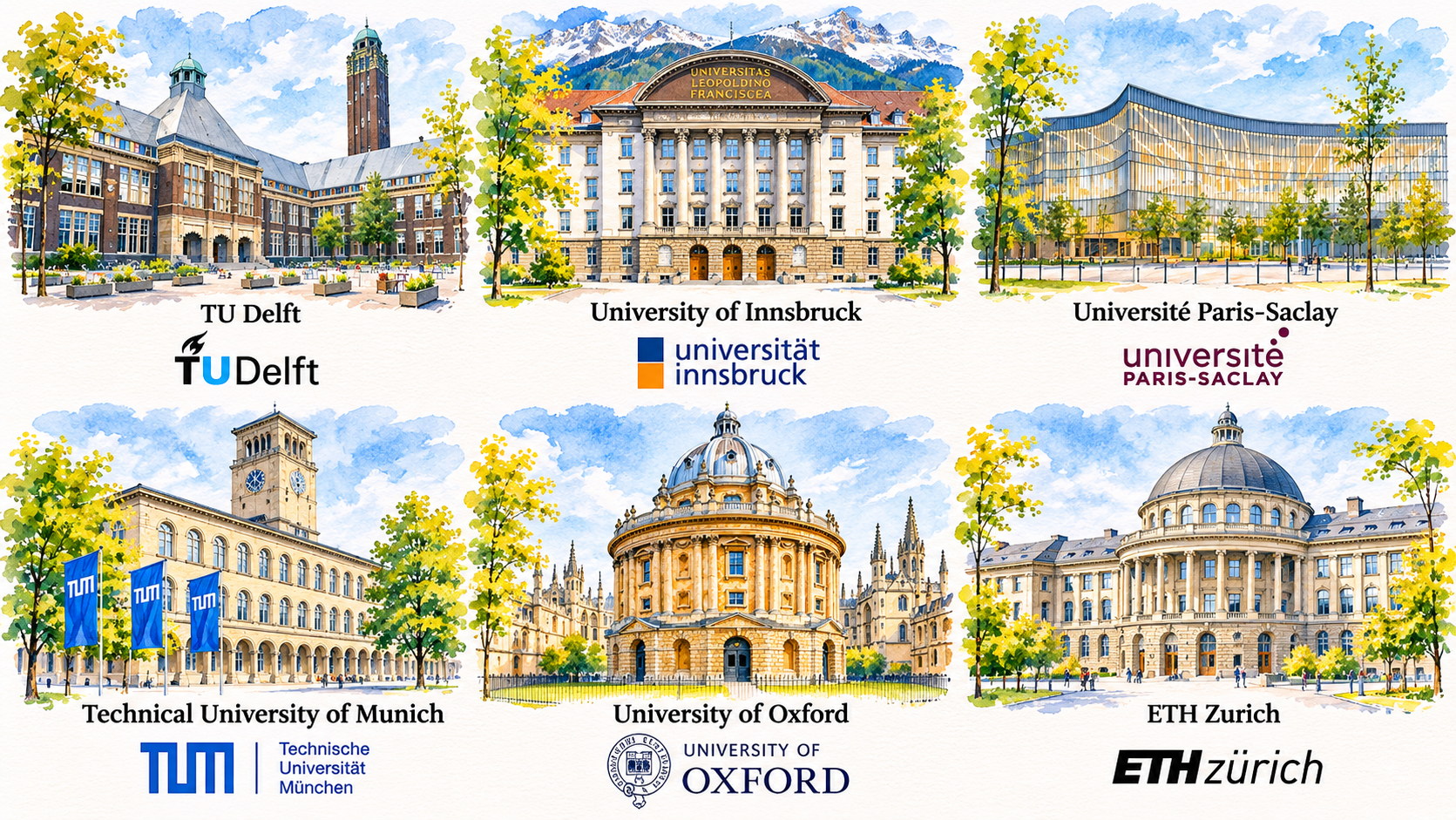
From Delft and Innsbruck to Paris, Munich, Oxford and Zurich, European universities are developing technologies that could redefine computing, communications and industrial innovation. Can scientific leadership become industrial power?
While Brussels advances its proposed Quantum Act and €50 billion Sovereign Tech Equity Fund, much of Europe’s technological future is already taking shape inside university laboratories. European researchers are connecting quantum processors, manipulating individual atoms, developing new computing architectures and tackling one of the field’s greatest challenges: making quantum computers reliable.
But there is no single path towards the quantum future. Europe’s strength may lie precisely in the diversity of its scientific approaches.
🟦 1 | TU Delft, Netherlands — Building the quantum internet
At QuTech, established by TU Delft and TNO, researchers are developing technologies that could eventually connect quantum computers across geographically separated locations.
In March 2025, an international research team led by QuTech introduced QNodeOS, an operating system designed to run applications on quantum networks.
Its architecture was demonstrated across fundamentally different hardware platforms, including diamond-based quantum processors and trapped-ion technology developed in Innsbruck.
Future applications could include distributed quantum computing and new forms of secure communication.
The tension: Europe is helping develop the foundations of a quantum internet. But who will build, operate and commercialise its infrastructure?
🟦 2 | University of Innsbruck, Austria — Computing with individual atoms
Researchers in Innsbruck use electrically charged atoms, known as ions, as the fundamental building blocks of quantum computers.
The university is also closely connected to industrial development through its spin-off Alpine Quantum Technologies (AQT).
In October 2026, the Quantum Internet Alliance announced €47.5 million in new European funding to advance the development of a quantum internet prototype, bringing together more than fifty research and industrial partners.
The tension: extraordinary precision inside a laboratory does not automatically translate into affordable, scalable industrial systems.
🟦 3 | Université Paris-Saclay, France — Turning fundamental physics into industry
Within the Paris-Saclay research ecosystem, scientists are developing quantum systems using neutral atoms controlled by lasers.
This approach has already generated commercial activity. Pasqal, founded in 2019, emerged from research conducted at the Institut d’Optique Graduate School.
Potential applications include materials research, scientific simulation and industrial optimisation.
The tension: scientific discovery can create new companies. Building internationally competitive companies requires an entirely different set of capabilities.
🟦 4 | Technical University of Munich, Germany — Moving towards industrial production
Through the Munich Quantum Valley ecosystem, researchers are connecting quantum science with engineering, semiconductor fabrication and industrial development.
In July 2025, the European Union approved SUPREME, a pilot-line initiative coordinated by Finland’s VTT to advance the industrial fabrication of superconducting quantum chips.
The initiative brings together 23 partners from eight EU member states, with three principal fabrication sites planned in Finland, Germany and the Netherlands.
The tension: Europe is developing manufacturing capabilities for quantum hardware. Future demand and economically viable production volumes remain uncertain.
🟦 5 | Beyond the EU: Oxford and ETH Zurich — Scaling and reliability
Beyond the European Union, two major European research centres are tackling fundamental challenges in quantum computing.
In February 2025, researchers at the University of Oxford demonstrated how physically separated quantum processors could perform computational operations through an optical network connection.
At ETH Zurich, researchers are advancing superconducting quantum circuits and error correction — technologies intended to overcome the inherent fragility of quantum information.
The tension: increasing computing power is only part of the challenge. That power must also become dependable, accessible and economically useful.
🟦 6 | Who will educate the quantum generation?
Quantum technology requires more than physicists. Engineers, software developers, cybersecurity specialists and industrial application experts will also be needed.
ETH Zurich already offers a dedicated master’s degree in Quantum Engineering, while the European Commission launched a Quantum Digital Skills Academy in 2026.
The tension: Europe can educate the next generation of quantum specialists. Can it also offer them the industrial opportunities to build their careers here?
🟦 THE SIGNAL
Europe’s quantum strength lies not in a single university, company or technological architecture, but in a diverse and increasingly interconnected scientific ecosystem. Its challenge is to connect that ecosystem with capital, manufacturing capacity, industrial customers and long-term career opportunities.
The next quantum revolution may emerge from Europe’s laboratories. The question is whether its industries, products and economic value will remain in Europe too.
🟦 EUROPE’S QUANTUM RESEARCH LANDSCAPE
Six leading European research centres and their technological specialisations.
| University / Research Centre | Country | Core expertise | Industrial potential |
|---|---|---|---|
| TU Delft / QuTech | 🇳🇱 Netherlands | Quantum networks | Distributed computing and secure communications |
| University of Innsbruck | 🇦🇹 Austria | Trapped-ion computing | Quantum processors and networking |
| Université Paris-Saclay | 🇫🇷 France | Neutral-atom computing | Scientific simulation and materials research |
| Technical University of Munich | 🇩🇪 Germany | Quantum engineering | Quantum chip fabrication and industrial hardware |
| University of Oxford | 🇬🇧 United Kingdom | Distributed quantum computing | Scalable computing architectures |
| ETH Zurich | 🇨🇭 Switzerland | Superconducting circuits and error correction | Reliable quantum computing systems |
Source: Altair Media analysis based on university research publications and European research initiatives. The selection is illustrative rather than a ranking. Research specialisations are not exclusive, and potential industrial applications remain at different stages of technological maturity.
Credit
Illustration: Altair Media / OpenAI (AI-generated editorial watercolour).
Caption
Europe’s Quantum Powerhouses. An editorial watercolour featuring the distinctive academic architecture of six leading European research institutions: TU Delft / QuTech, the University of Innsbruck, Université Paris-Saclay, the Technical University of Munich, the University of Oxford and ETH Zurich.
Together, these institutions represent the depth, diversity and scientific heritage of Europe’s emerging quantum ecosystem.
University buildings and emblems are artistically interpreted.
