Silicon Saxony’s €16 Billion Expansion — What Does Europe Gain?
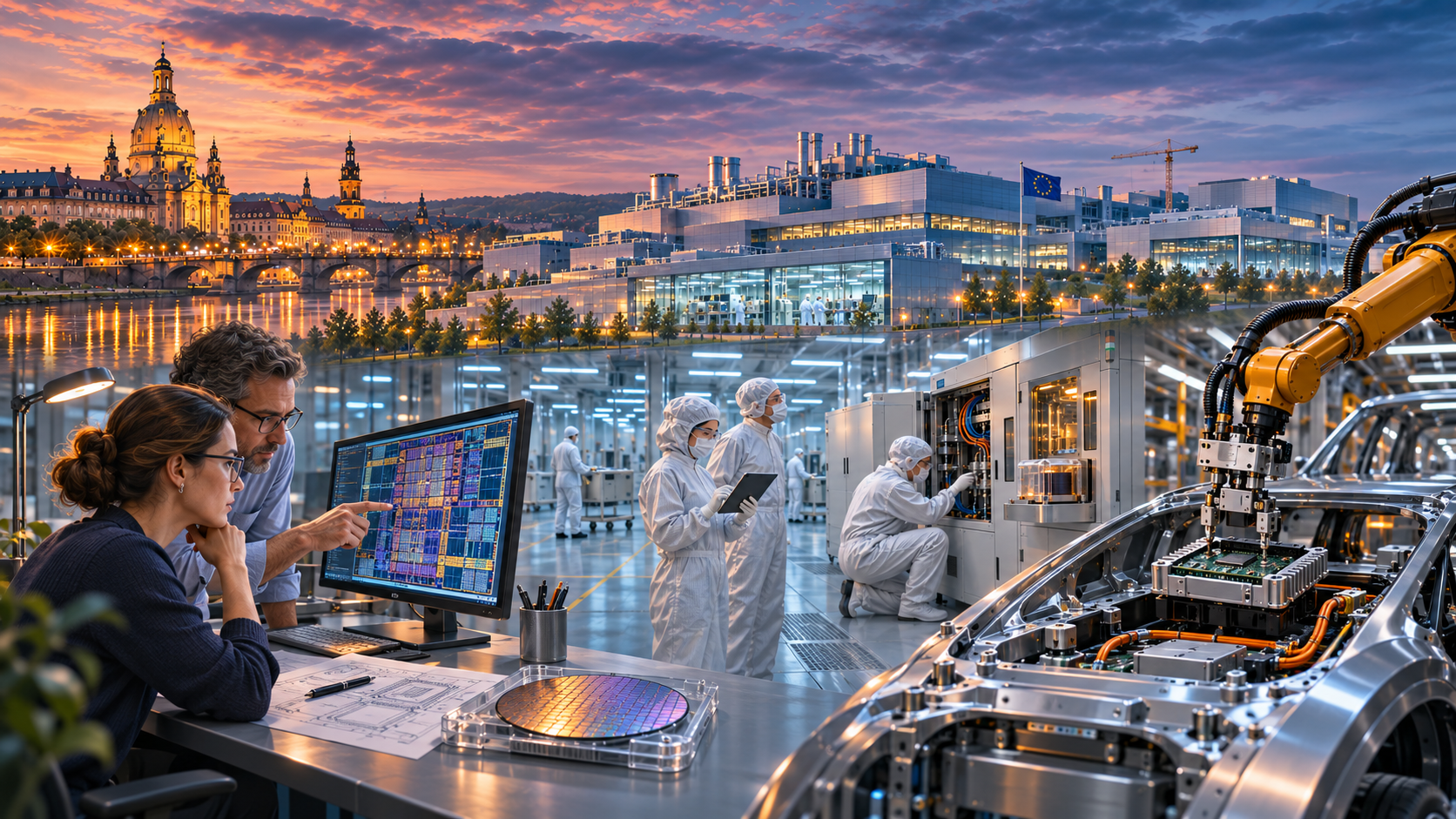
The European test lies in who can use Dresden’s new capacity.
Infineon, ESMC and GlobalFoundries have announced more than €16 billion in investment across three Dresden projects. The expansion adds production capacity and brings TSMC manufacturing technology to Silicon Saxony. Its European significance will depend on the companies that can use it, the products they build and the access they obtain to production.
A factory in Saxony becomes European industrial infrastructure when companies elsewhere can build products around it. Will these investments give them more reliable supply, competitive manufacturing and a route from new designs to repeat orders?
🟦 Can Europe’s manufacturers turn this capacity into an advantage?
How customers use that capacity depends on the business model. Infineon makes its own products in Dresden. ESMC and GlobalFoundries manufacture chip designs for external customers. A customer may therefore be buying a finished Infineon chip or commissioning production of its own design.
| Project | Stated investment | What changes |
|---|---|---|
| Infineon Smart Power Fab | €5 billion | More capacity for power and analogue chips. The factory opened on 2 July 2026. |
| ESMC | More than €10 billion | A new factory making customers’ chip designs using TSMC technology. Equipment installation is expected in 2027. |
| GlobalFoundries SPRINT | €1.1 billion | More capacity for energy-efficient chips used in vehicles, industry and connected devices, targeted for the end of 2028. |
Together, the stated budgets exceed €16.1 billion. They cover projects at different stages over several years, with public support included in the relevant project financing.
Their potential reach extends into vehicles, factory equipment, communications and energy systems. For a machine builder or automotive supplier, the benefit comes when those capabilities help it deliver a product more reliably or competitively. A nearby factory still has to earn a place in the customer’s design and purchasing decisions.
🟦 Could a chip designed in Eindhoven be manufactured in Dresden?
Axelera AI provides a concrete example. In an interview published on 20 August 2026, CEO Fabrizio del Maffeo said its Metis AI chip could potentially be manufactured in Dresden from 2028. Metis currently uses a 12nm TSMC process, and ESMC’s announced technologies include 12nm manufacturing.
That would connect a Dutch chip designer with production inside the EU. Metis already uses TSMC technology, giving the company a reason to investigate the related manufacturing platform planned for Dresden.
The transfer would still require testing, technical preparation, available capacity and commercial agreements. For other European designers, the same questions apply. A suitable manufacturing process becomes commercially useful when they can access it at a cost their products can support.
🟦 Is Silicon Saxony becoming a rival to Nvidia?
Nvidia competes through its own processors, systems and software. It uses manufacturing partners, including TSMC, to make its chips. ESMC will manufacture designs supplied by customers. The technologies announced for Dresden also differ from those used for Nvidia’s Blackwell processors. s201.q4cdn.com
Silicon Saxony can contribute to the AI economy through several routes. These include manufacturing suitable AI processors for companies such as Axelera and making the power chips needed to supply electricity efficiently to servers.
A European company competing in AI also needs designs, software, systems and customers. The investment in Dresden can strengthen its manufacturing options. Its competitive position will depend on how successfully it combines those capabilities into a product people buy.
🟦 Will the expansion close Europe’s photonics gap?
Europe already has photonic-chip manufacturers. SMART Photonics in Eindhoven makes chips that use light for functions including carrying and processing information. Such production requires specialised manufacturing platforms and precise assembly and testing.
Connections between those platforms are developing. On 21 September 2026, SMART Photonics announced a partnership with GlobalFoundries to combine their photonics technologies in a service for customers. General availability is targeted for the second half of 2027. The announcement leaves the production locations unspecified.
This illustrates why Europe’s manufacturing needs must be examined technology by technology. The three Dresden projects expand particular electronic-chip capabilities. The availability, cost and scale of photonics production remain separate questions that require their own investment and evidence.
🟦 How much control does production in Europe create?
TSMC holds 70 per cent of ESMC and will operate the Dresden factory using its manufacturing technology. For a chip designer, this means working within TSMC’s manufacturing rules and relying on its process expertise. Europe gains a local production base through a continuing technological relationship with TSMC.
Public policy has a practical role within that structure. The European Commission’s approval of €5 billion in German state aid includes commitments supporting access for smaller European businesses and universities. ESMC also committed to comply with priority orders for crisis-relevant products under the EU Chips Act.
Those commitments can help turn the investment into wider industrial security. Their effect will depend on which designs the factory can make, which customers can obtain capacity and how production is allocated when demand is strong or supplies are disrupted.
🟦 Who earns the return beyond the factory gates?
The investments build on a substantial existing ecosystem. Saxony recorded around 82,500 employees in microelectronics and ICT in 2025, with almost half working in software. Its industrial base extends well beyond the people operating chipmaking equipment.
ESMC’s search for suppliers covers installation, maintenance, logistics, specialist materials and other services needed to keep a factory running. Such work creates opportunities for companies that can meet demanding standards consistently. The experience can also help them win business at other sites.
Our assessment is that Silicon Saxony can strengthen Europe’s industrial position through these connections between regions. A chip designer, a manufacturing partner and suppliers elsewhere in Europe can each gain business from the same product. The wider return will grow when access to Dresden’s capacity helps those companies launch products and secure continuing orders.
Signal
Silicon Saxony’s investment wave gives Europe more capacity to make the chips its industries need. The return depends on customers being able to use that capacity at a competitive cost, on workable terms and with orders that sustain production.
Explore the Silicon Saxony series
Three investments, three different roles in Europe’s chip industry:
- GlobalFoundries: expanding Dresden’s industrial chip capacity
What a €1.1 billion expansion means for automotive, industrial applications and AI. - Infineon: a €5 billion bet on power chips
Why managing electricity matters for data centres, vehicles and energy systems. - ESMC: from construction to chip production
How TSMC and its European partners are preparing Dresden’s newest factory for production.
Credit
AI-generated illustration for Altair Media Europe, created with OpenAI.
Caption
Conceptual illustration connecting Dresden’s skyline with chip design, semiconductor manufacturing and industrial applications. Silicon Saxony’s European significance will depend on how effectively these activities work together.
