Nvidia’s French Bet: Financing the Demand for AI
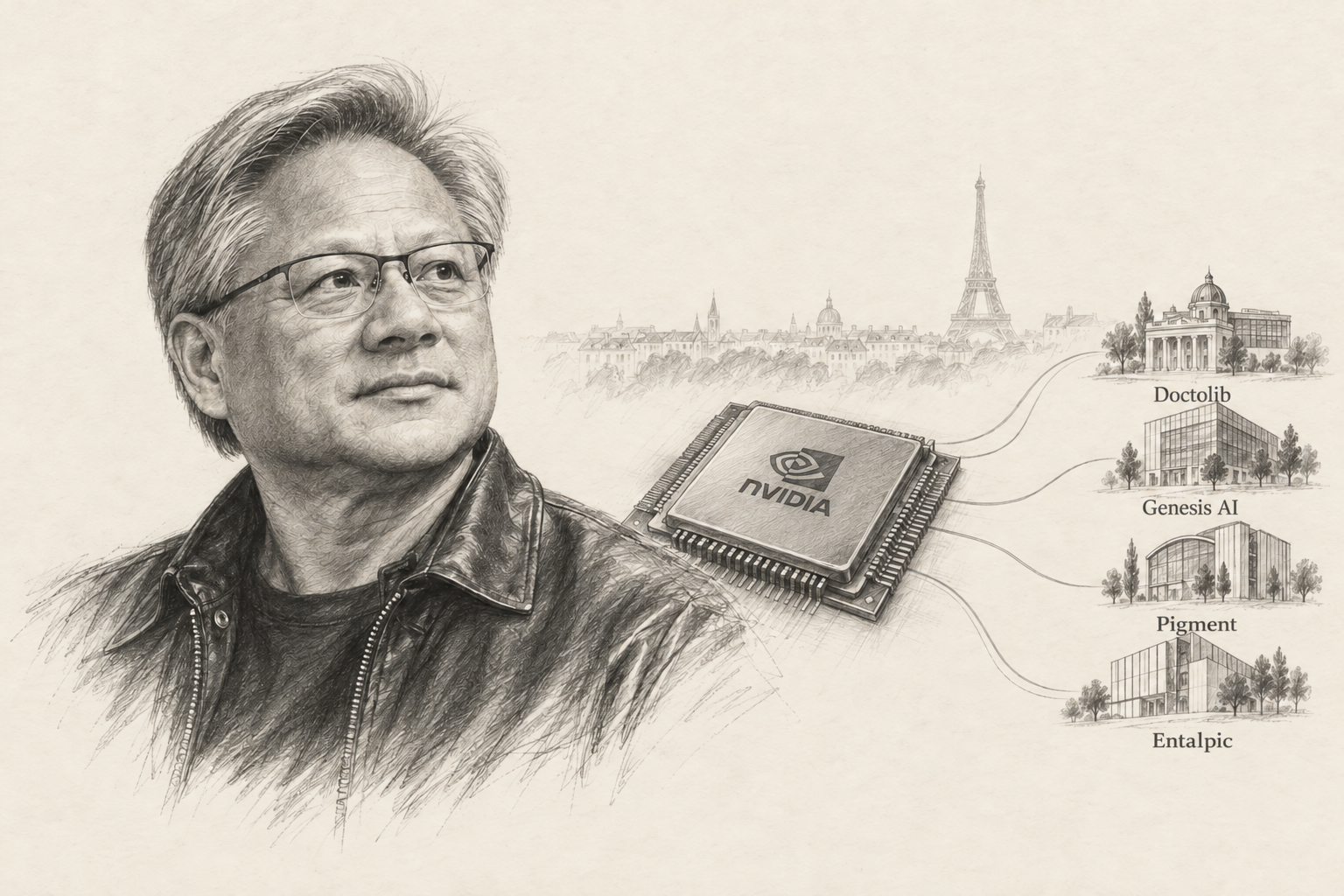
Planned investments in four French technology companies highlight the commercial tension when an AI supplier also becomes an investor.
Nvidia has announced planned investments in Doctolib, Genesis AI, Pigment and Entalpic, spanning healthcare, robotics, business planning and materials discovery. The amounts remain undisclosed. For Europe, the prospect is faster development. For Nvidia, the strategic payoff could extend beyond equity returns: sustained demand for the computing architecture at the heart of its business.
The strategic question is how much freedom these companies retain as capital, technical support and infrastructure become more closely connected.
🟦 Is Nvidia backing French innovation — or cultivating future customers?
Both interests can coexist. Nvidia identifies all four companies as investment targets; Reuters separately reports Doctolib’s confirmation of a minority stake and Genesis AI’s confirmation of Nvidia as a strategic investor. The announcement does not establish exclusive purchasing obligations.
The commercial logic is nevertheless clear: financing useful AI applications can help expand the market for AI computing. Nvidia could benefit from the value of its holdings and from additional demand for its technology. That is a strategic interpretation, rather than a disclosed condition of these deals.
🟦 Why invest in applications when Nvidia already supplies the infrastructure?
Because computing capacity needs work to do. Healthcare tools, robots, planning systems and materials research offer different routes from AI experimentation to recurring use.
The attractive scenario for Nvidia is that applications become embedded in everyday operations, making demand more durable. But adoption does not guarantee profitable demand. A successful application must create enough value to cover its computing costs. More efficient models, alternative hardware and customer resistance to pricing could all weaken the link between application growth and Nvidia revenue.
🟦 How much influence can a minority investor acquire without taking control?
An ownership percentage tells only part of the story. A company could remain formally independent while its engineering choices become increasingly tied to one supplier’s technology. Software libraries, optimized models and integrated workflows can make switching progressively more expensive.
For these investments, the relevant rights and commercial terms have not been disclosed. It would therefore be premature to claim Nvidia controls the companies or their technology choices. The harder question is practical: how much software would need to be rewritten, models reoptimized and workflows rebuilt to choose another platform? Those accumulated commitments can create influence, even without majority ownership.
🟦 Is this productive investment — or money circling back to the supplier?
There is a productive version of the model: investment supports development, customers pay for valuable services, and those revenues sustain the purchase of computing capacity. Supplier and application developer grow together.
A more fragile version would arise if invested capital funded computing expenditure without generating sufficient customer revenue. The French announcements do not establish that pattern. They do, however, make the distinction worth examining. The decisive evidence would be paying customers, sustainable margins and the ability to finance operations when the next investment round is no longer available.
🟦 Can European AI become stronger while its dependence also deepens?
Yes. European companies can build valuable products, expertise and intellectual property while relying on infrastructure supplied from outside Europe. Those gains are real.
The tension appears when faster development narrows future choices. Keeping data in Europe, owning an application and controlling its underlying infrastructure are different forms of autonomy. The strategic test is whether companies can adapt their systems, negotiate with competing suppliers and change direction at an acceptable cost. European ownership alone cannot answer that question.
🟦 What would make these investments a good bargain for Europe?
Capital and technical support would need to produce commercially viable companies with room to choose their own direction. Useful evidence would include portable systems, workable alternatives and clear separation between investment rights and purchasing decisions.
None of those safeguards should be presumed from the announcement. Neither should their absence. Europe’s task is to assess the bargain as the terms and operating results become visible. A company that grows quickly but loses bargaining power may face a very different future from one that uses investment to widen its options.
Signal
Nvidia’s French investments could strengthen European AI and expand the market for Nvidia technology at the same time. The tension sharpens if success makes changing supplier progressively harder. Europe should judge the bargain by the commercial value created and the choices its companies retain as they grow.
Credit
AI-generated illustration: Altair Media / OpenAI.
Caption
Jensen Huang alongside a symbolic representation of Nvidia’s planned investments in Doctolib, Genesis AI, Pigment and Entalpic—connecting European applications with the infrastructure powering their growth.
