From Steel to Satellites: Europe’s New Industrial Ambition
Strategic autonomy is no longer just a political ambition. It is becoming an industrial challenge
On 24 November 2026, Belgium inaugurated Europe’s largest satellite manufacturing facility in Charleroi. With a €100 million investment in the factory and a €2.4 billion contract to manufacture 264 satellite platforms for the European IRIS² programme, Aerospacelab’s expansion marks a significant moment in Europe’s attempt to translate technological sovereignty into industrial capacity.
Beyond the factory itself, five questions emerge about Europe’s industrial future.
🟦 1. Can public procurement create Europe’s next industrial champions?
European competitiveness is often discussed through the availability of private capital. Yet Aerospacelab demonstrates the transformative potential of long-term demand created by public infrastructure programmes. A strategic contract can provide the commercial certainty needed to invest in facilities, talent and production capacity.
The tension: Europe wants globally competitive companies, but is it prepared to become their long-term customer?
🟦 2. Does manufacturing satellites guarantee technological sovereignty?
IRIS² is intended to provide Europe with secure and resilient satellite connectivity. However, satellite manufacturing represents only one part of a much larger ecosystem involving launch capabilities, electronic components, software, ground infrastructure and operational control. Producing satellites in Europe does not automatically guarantee autonomous access to space.
The tension: European ownership does not necessarily eliminate external dependency.
🟦 3. Can Europe move from innovation to industrial scale?
As reported by Belgian business newspaper De Tijd, the Charleroi facility is designed to produce up to 500 satellites annually. This represents a shift towards industrial-scale space manufacturing. The challenge is no longer simply developing advanced technology, but producing it reliably, competitively and at volume.
The tension: Europe has considerable scientific expertise, but innovation alone does not create industrial power.
🟦 4. Who governs infrastructure that serves both civilians and defence?
IRIS² will support government communications, emergency services, security and defence, alongside commercial connectivity. This convergence creates new questions about access, investment priorities, operational control and public accountability.
The tension: Infrastructure designed to strengthen European sovereignty must also remain accountable to the societies it serves.
🟦 5. Can strategic industries revitalise Europe’s former industrial regions?
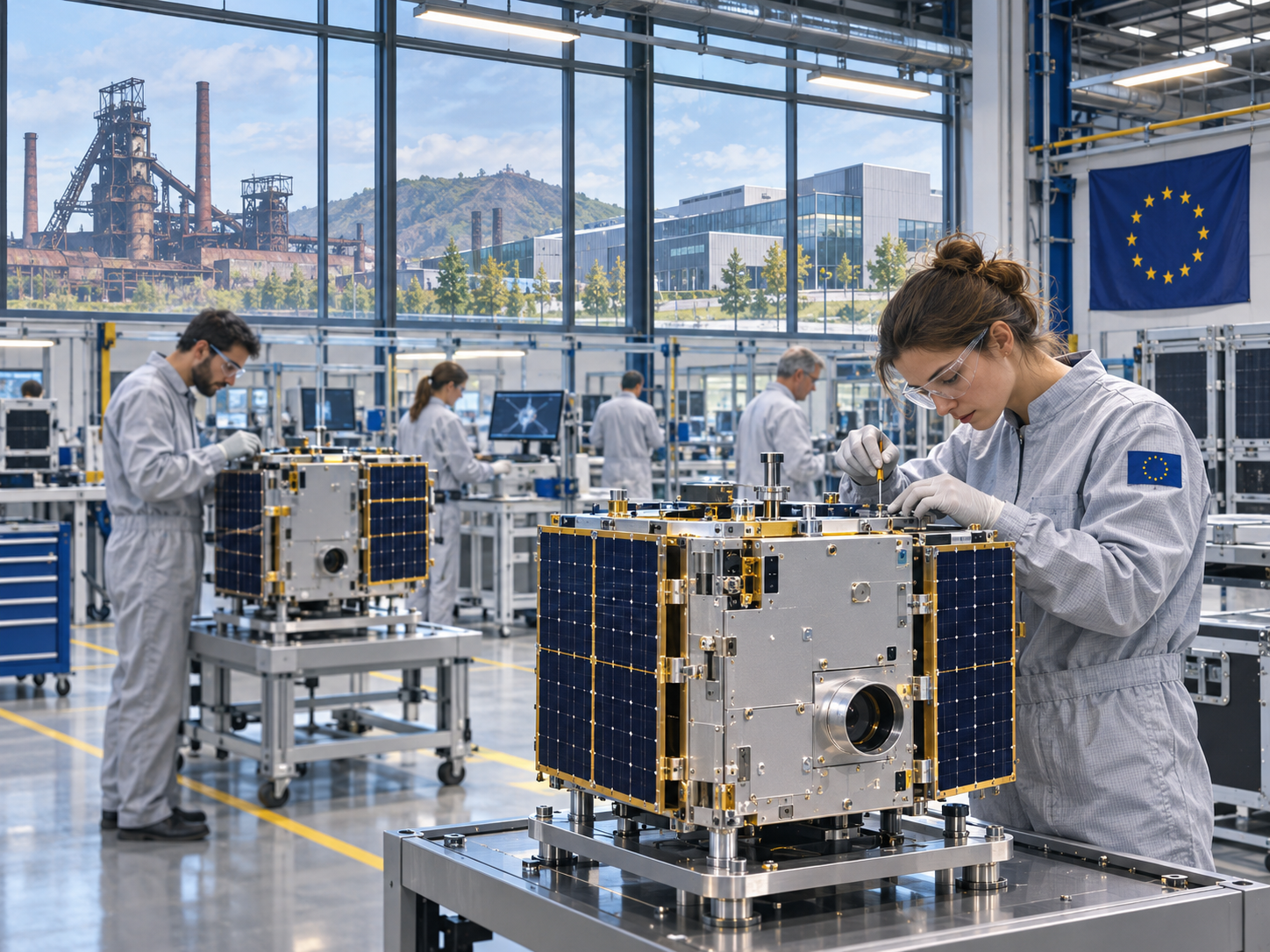
Charleroi’s industrial heritage provides an important perspective. A region historically associated with coal, steel and manufacturing decline is now positioning itself within the European space economy. The wider opportunity lies in developing sustainable employment, specialist skills and regional supply chains.
The tension: Strategic autonomy may be defined in Brussels, but its economic and social consequences are experienced locally.
🟦 The Altair Signal
Europe’s next industrial transformation will depend not only on its ability to mobilise capital or develop technology, but on its capacity to create sustained demand, build production ecosystems and connect strategic investment with regional economic renewal.
Charleroi offers an early indication of what that transformation could look like. The real test will be whether Europe can replicate it.
Image credit
Altair Media | AI-generated editorial illustration.
Image caption
From steel to satellites: Charleroi’s industrial heritage provides a backdrop to Europe’s emerging space manufacturing ambitions, illustrating the connection between technological sovereignty, industrial capacity and regional economic renewal.
