Europe Has Twelve Priorities. Who Will Turn Them into Partnerships?
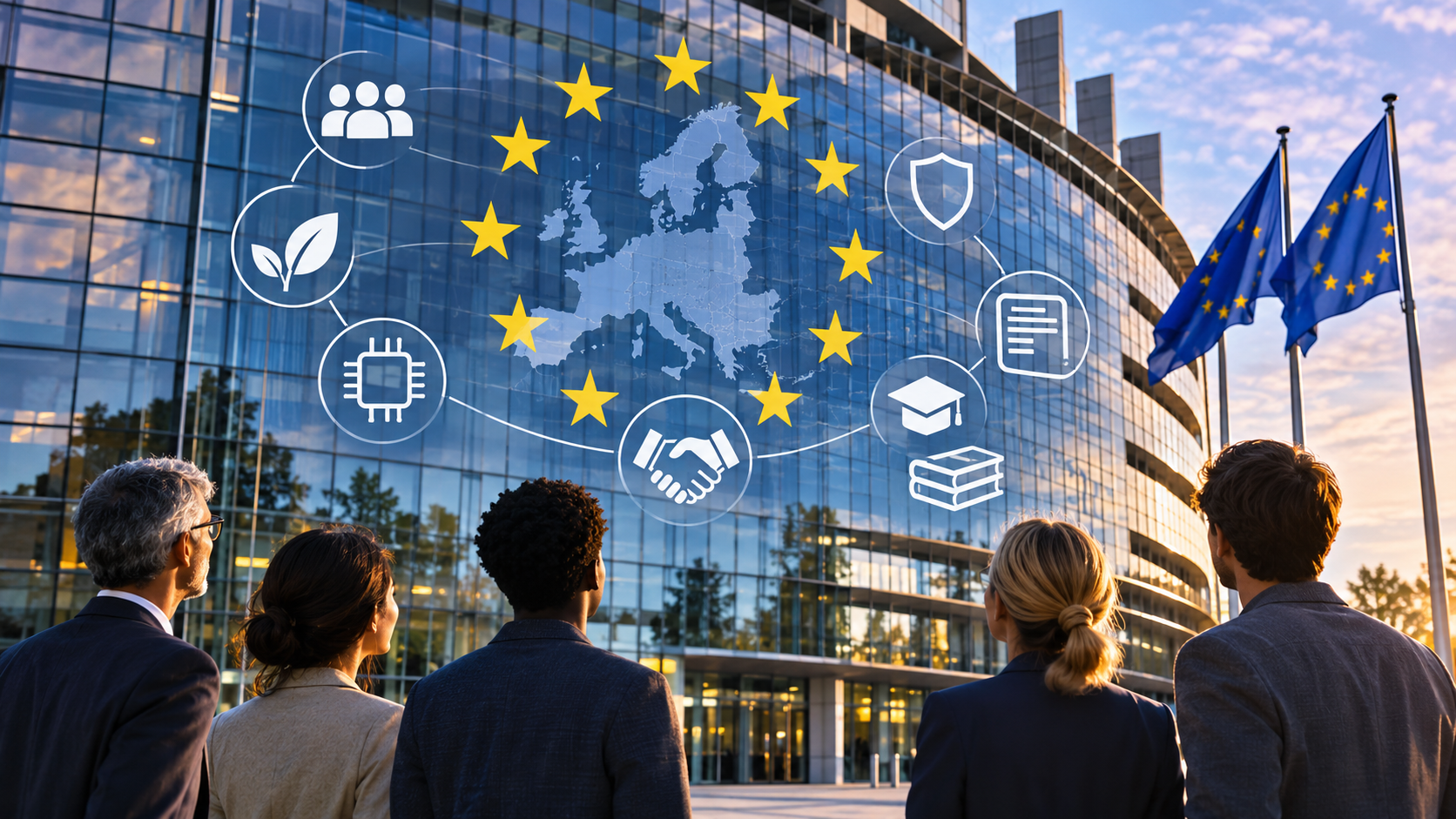
EuropaNova’s Strasbourg conference sets out an ambitious agenda. Turning it into results will require more than political agreement.
Europe wants stronger democracy, greater technological independence and more influence in world affairs. But governments cannot achieve these ambitions alone. At the Europa Power Conference in Strasbourg, more than 300 participants from politics, business, science and civil society identified twelve priorities. Their proposals raise a practical question: who will turn Europe’s ambitions into lasting cooperation?
Organised by European think tank EuropaNova from 21 to 23 October 2026, the conference concluded at the European Parliament.
The twelve priorities cover four ambitions: democratic participation, economic strength, global influence, and scientific and cultural freedom. They are intended to influence European policy, but are not binding commitments.
Europe has identified what it wants to achieve. The next question is how and with whom.
Five questions explore where interests meet, where tensions arise and what it takes to turn the Strasbourg agenda into working partnerships.
⭐ 1. Can Europe make decisions faster while giving citizens more influence?
Faster decisions may help Europe act. But speed does not automatically strengthen democracy.
EuropaNova’s first four priorities focus on democratic and civic power:
- Simplify and accelerate European decision-making.
- Give citizens greater direct influence over European decisions.
- Make Europe a model of gender equality and women’s leadership.
- Empower young people to sustain a humanist and democratic Europe.
These goals are closely connected, but they can also conflict.
Faster decisions may leave less time for public debate. Greater participation requires opportunities for citizens to influence proposals and challenge decisions.
Universities, civic organisations and public institutions could help develop new ways of involving citizens. But how can Europe demonstrate that participation makes a difference? A faster Europe is not necessarily a more democratic Europe.
⭐ 2. Can European investment strengthen both industry and society?
Europe needs investment. But investors, governments and citizens do not always seek the same results.
Three priorities focus on prosperity and sustainability:
- Mobilise European capital and savings for strategic priorities.
- Combine climate policy with stronger purchasing power for Europeans.
- Build European champions in the major technologies of the future.
These ambitions could bring together banks, investors, businesses, universities and governments.
Yet their interests differ. Investors seek returns, businesses want growth and governments pursue public goals.
Impact Europe, which participated in Strasbourg, wants more capital directed towards social enterprises and projects with measurable public benefits.
That raises important questions. Who decides where money goes? Who takes the risks? And who benefits from the results?
More investment can create economic power. Its public value depends on where that investment goes.
⭐ 3. Can Europe become stronger through international cooperation?
Europe wants greater independence. But international influence also depends on trusted partners.
Two priorities address Europe’s global position:
- Build European capacity to ensure security while defending human rights and the rule of law.
- Mobilise Europe’s intellectual and cultural resources to defend democracy.
These ambitions reach beyond defence and diplomacy.
Research institutions, cultural organisations and civil society networks can help countries share knowledge, strengthen democratic institutions and respond to common challenges.
International cooperation could also help Europe learn how other democratic societies balance economic interests and public responsibility.But successful cooperation requires clear goals and mutual benefits.
International influence is not only about Europe’s strength. It also depends on its ability to work with others.
⭐ 4. Can research and journalism remain independent while serving Europe’s ambitions?
Science and journalism can strengthen Europe. Their credibility depends on the freedom to question power.
The final three priorities concern scientific and cultural strength:
- Protect media independence and European journalism.
- Protect academic freedom and make European science a driver of innovation.
- Secure Europe’s future as a place of creativity, culture and sharing.
These goals create opportunities for universities, researchers, publishers and cultural organisations to work together. But cooperation also has limits.
Research must remain free to challenge political priorities. Journalists must be able to investigate the institutions and companies they cover.
Funding and partnerships can support this work, provided independence is protected.
Knowledge strengthens democracy not only when it supports policy, but also when it challenges it.
⭐ 5. Who will turn the twelve priorities into working partnerships?
A shared agenda creates opportunities. It does not guarantee results.
EuropaNova has already brought together organisations from politics, business, research and civil society.
One example is the Social Enterprises and Impact Organisations network, co-founded by Impact Europe alongside organisations including Euclid Network, Ashoka, Groupe SOS and academic partners.
Such networks can connect expertise, funding and practical experience. But important questions remain.
Who will lead new projects? What will partners contribute? Who carries the risk when initiatives stall? And how will results be measured?
These questions matter because cooperation requires more than good intentions.
A partnership becomes meaningful when shared ambitions lead to clear commitments and measurable results.
Altair Partnerships
The Europa Power Conference has connected twelve priorities with a growing European network of organisations.
Turning those priorities into action will require cooperation between institutions, businesses, researchers and citizens.
Their interests will not always align. That makes clear responsibilities, transparency and measurable results essential.
Europe does not lack shared ambitions. The challenge is building partnerships capable of turning them into accountable action.
For EuropaNova and its networks, the next test will be what happens after Strasbourg.
Sources
- EuropaNova — 12 Priorities for a Stronger Europe, 26 October 2026.
- Impact Europe — European Power Begins With Trust, 6 November 2026.
Image Credit
AI-generated editorial illustration | Altair Media Europe
Image Caption
From shared ambitions to lasting partnerships. EuropaNova’s twelve priorities highlight the challenge of bringing European institutions, businesses, researchers and civil society together to strengthen Europe’s future.
