Airbus Defence and Space and the Return of Sovereignty
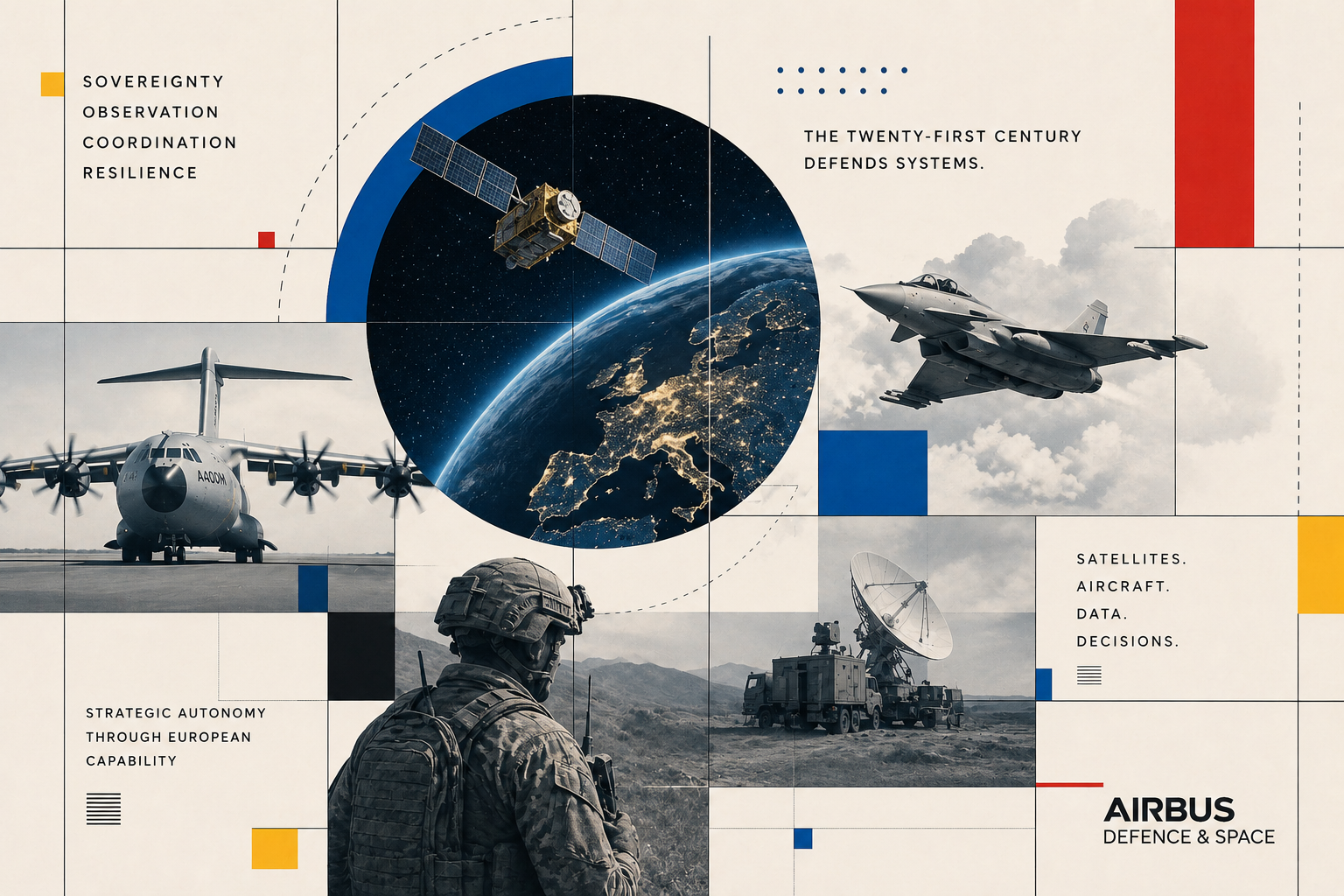
Why defence, satellites and strategic autonomy are becoming increasingly connected
For much of the post-Cold War period, sovereignty was increasingly understood through economic integration. Markets expanded, supply chains globalised and defence capabilities became embedded within broader international systems. Strategic autonomy appeared less urgent in a world characterised by interdependence. Today, that assumption is being reconsidered.
Russia’s invasion of Ukraine, geopolitical fragmentation and growing concerns about technological dependence have reintroduced an older question into European politics. What capabilities must societies retain if they wish to remain strategically autonomous in an increasingly contested world?
For Airbus Defence and Space, this question is no longer theoretical. It defines the sector itself.
The Sovereignty Axiom: Strategic autonomy is no longer measured solely by military expenditure. It is increasingly measured by the ability to observe, communicate, navigate and coordinate independently.
Or, put differently:
The twentieth century defended territory. The twenty-first century defends systems.
🟦 The Sovereignty Question
What does sovereignty look like when warfare, data and space become inseparable?
For centuries, sovereignty was primarily associated with territory, borders and military power. Today, sovereignty increasingly depends upon infrastructure.
Observation satellites determine what governments can see. Communications networks determine what armed forces can coordinate. Navigation systems determine what platforms can move, what weapons can target and what supply chains can function. Data increasingly determines situational awareness.
Space has therefore evolved from a domain of prestige into a domain of infrastructure.
Airbus Defence and Space operates precisely at this intersection. Its activities span military transport aircraft, secure communications, intelligence systems, Earth observation platforms and satellite technologies that have become deeply embedded within Europe’s strategic architecture.
The question is therefore no longer whether space matters. The question is who controls the systems upon which modern societies depend.
🟦 The Observation Question
Satellites and the Politics of Seeing
Can societies remain autonomous if they cannot independently observe the world around them?
Modern conflicts increasingly demonstrate that observation itself has become a strategic capability. Satellite imagery shapes diplomatic responses, military planning and economic resilience. Persistent monitoring provides governments with an independent understanding of events beyond their borders.
Yet observation is no longer merely about collecting information. It is also about interpretation.
Satellites generate enormous volumes of data, but sovereignty increasingly depends upon who possesses the analytical tools capable of transforming information into insight. If Europe observes through European satellites but relies upon external AI systems to interpret the results, strategic autonomy remains incomplete.
Airbus therefore represents more than manufacturing capacity. It represents Europe’s attempt to maintain an independent capacity to see.
🟦 The Coordination Question
The A400M and the Geography of Power
Can Europe project influence without controlling its own logistical capabilities?
Military power is often associated with advanced fighter aircraft and sophisticated weapons systems. Yet history repeatedly demonstrates that logistics frequently determines outcomes.
Troops, humanitarian assistance, equipment and rapid deployment all depend upon transport capacity.
The A400M programme emerged from precisely this concern. Europe sought to reduce dependence upon external transport capabilities and strengthen its own ability to respond independently during crises.
The programme experienced delays, political tensions and cost overruns. Yet this misses the deeper point. Strategic autonomy rarely emerges through efficiency. It emerges through persistence.
Capabilities that appear expensive, redundant or inefficient during periods of stability often prove indispensable during periods of uncertainty.
The Sovereignty Paradox: Europe seeks strategic autonomy, yet autonomy itself requires a level of cooperation that inevitably constrains national control.
Airbus demonstrates that sovereignty in the twenty-first century is increasingly built through shared capabilities rather than purely national assets.
🟦 The Defence Question
Eurofighter and Shared Capability
Can sovereignty be pooled without becoming diluted?
Few programmes illustrate this dilemma more clearly than Eurofighter. The project reflects both the ambition and the complexity of European capability building. National priorities differ, industrial interests compete and political cycles evolve. Yet despite these frictions, the programme persists. Its significance lies beyond the aircraft itself.
Eurofighter demonstrates that sovereignty in contemporary Europe increasingly depends upon institutions capable of sustaining cooperation despite disagreement.
Europe may therefore be developing a distinctive model of strategic autonomy.
Not sovereignty as centralisation. But sovereignty as coordination.
🟦 The Infrastructure Question
From Prestige to Utility
At what point does space cease to be exploration and become infrastructure?
For decades, space was associated with scientific prestige and symbolic achievement. It represented exploration, discovery and national ambition. Increasingly, however, space resembles a utility.
Satellites support communications, navigation, agriculture, financial transactions, weather forecasting, emergency services, energy networks and military operations. Without them, modern societies would experience immediate disruption.
The Infrastructure Shift: Space is no longer primarily a domain of exploration. It has become an operational layer of modern civilisation.
Dependence upon external space capabilities increasingly resembles dependence upon foreign energy supplies or foreign cloud providers. The strategic implications are profound.
The Altair Perspective
Airbus Defence and Space reveals a broader transformation in the meaning of sovereignty itself. The twentieth century defended territory. The twenty-first century increasingly defends systems. Observation. Communication. Mobility. Coordination. Resilience. These capabilities increasingly determine strategic autonomy.
Airbus therefore matters not simply because it manufactures satellites, transport aircraft or defence technologies. It matters because it illustrates how Europe attempts to sustain capabilities that no single nation can maintain alone.
This raises another question that becomes increasingly relevant as Europe debates artificial intelligence, cloud infrastructure, advanced semiconductors and energy systems.
Can Europe realistically build every strategic capability itself? Or will sovereignty increasingly depend upon identifying those domains in which specialisation becomes indispensable?
That question leads directly into the next chapter of this series.
Part 3 — Airbus Helicopters and the Value of Specialisation.
The twentieth century defended territory. The twenty-first century increasingly defends systems.
Part 2 of the series Airbus and the Architecture of European Capability, exploring how Europe builds and sustains capabilities through scale, sovereignty, specialisation and strategic capacity.
Credit
Illustration by Altair Media (AI-assisted visualisation inspired by European modernism, aerospace systems and strategic infrastructure)
Caption
Airbus Defence and Space illustrates the changing nature of sovereignty in the twenty-first century. Satellites, military mobility, observation systems and secure communications increasingly form the invisible infrastructure upon which strategic autonomy depends.
