Europe Has More Innovation Than It Can Fund
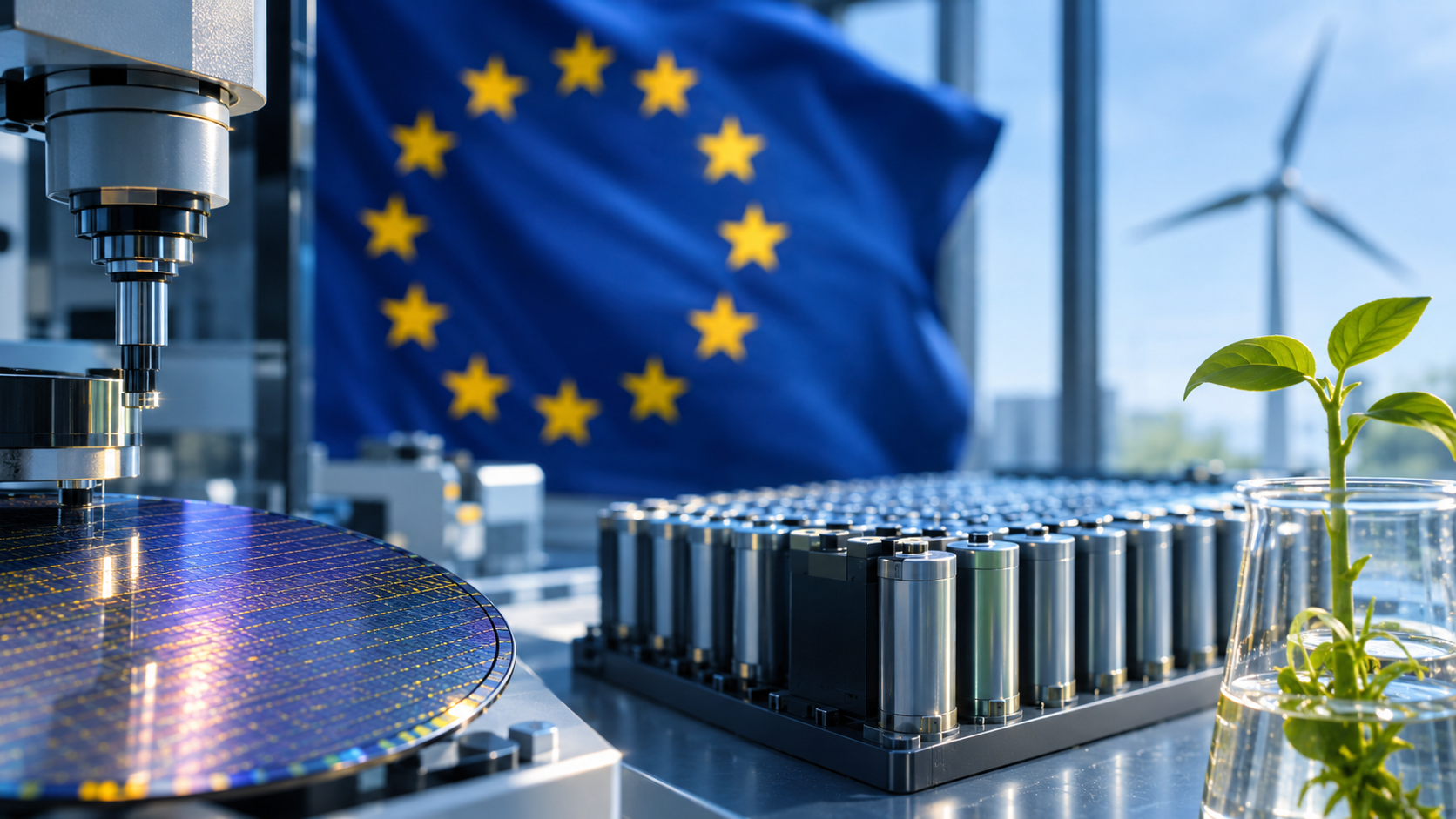
Europe’s deep-tech ambitions face a critical test of capital and industrial scale.
On 16 November 2026, the European Innovation Council (EIC) announced its latest selection of 35 deep-tech companies for Accelerator support. Their technologies range from underwater robotics and PFAS destruction to semiconductor manufacturing, battery materials and advanced medical research.
Yet the announcement revealed something beyond Europe’s technological ambitions. Another 74 applications passed the evaluation threshold but could not be funded within the available budget.
That contrast raises a fundamental question about Europe’s innovation economy: can it mobilise the capital, industrial capacity and commercial partnerships needed to turn promising technologies into lasting economic strength?
Beyond the allocation of public funding lies a broader challenge: supporting promising companies throughout their development, from technological breakthroughs to commercially viable industrial businesses.
Five questions reveal where the opportunities and obstacles lie.
❤️ What do the 35 selected companies reveal about Europe’s technological strengths?
The latest selection demonstrates Europe’s ability to generate innovations across several strategically important industries.
In Sweden, AlixLabs is developing technology for advanced semiconductor manufacturing, while Oxyle in Switzerland aims to destroy persistent PFAS chemicals using light-based processes. Portugal’s Seamoretech is working on recovering valuable minerals from desalination brine, and Poland’s Ecobean is developing modular biorefineries that turn industrial coffee waste into higher-value ingredients.
These businesses operate in very different markets, but they share an important characteristic. Their technologies require more than a successful laboratory demonstration. Commercialisation may involve specialised equipment, industrial facilities, regulatory compliance and extensive testing before customers are prepared to adopt them.
That makes deep-tech development fundamentally different from many conventional software businesses. A promising prototype can require years of engineering, investment and industrial validation before it produces meaningful commercial returns.
For Europe, this is both an opportunity and a challenge. The selected companies address problems in sectors where technological expertise can contribute to long-term competitiveness, environmental performance and industrial resilience. But technological capability alone does not establish a competitive industrial position.
The Dutch connection: Three companies, one industrial challenge
The three selected companies from the Netherlands illustrate how different technologies can contribute to broader European ambitions around resource efficiency and industrial competitiveness.
LeydenJar is developing silicon anode technology for batteries, Back to Battery is working on recovering critical raw materials from end-of-life lithium-ion batteries and Recell Group is developing a process to produce bioethanol from industrial and consumer waste.
The first two address different parts of the battery value chain, while Recell focuses on converting residual materials into a valuable product. Together, they illustrate the growing importance of materials technology, resource recovery and the transition towards more circular industrial processes.
They are not necessarily part of one integrated industrial cluster. Their common challenge is more fundamental: translating specialised technologies into commercially viable production at scale.
The tension: Europe can develop sophisticated technologies, but industrial success requires much more than technological excellence.
❤️ Why did 74 promising applications miss out on funding?
The EIC Accelerator is highly competitive. With 35 companies selected from 453 full applications, the latest round produced a selection rate of approximately 7.7%.
However, the unsuccessful applications deserve closer examination. According to the EIC, another 74 proposals were assessed above the required evaluation threshold but could not receive funding because the available budget was insufficient.
These applicants will receive a Seal of Excellence, designed to help them access alternative sources of financing. The recognition signals that their proposals met the relevant assessment threshold, but it does not provide the financial resources needed to implement their projects.
An important distinction must be made here. Passing the evaluation threshold does not mean that all 74 proposals were equally strong, commercially mature or comparable to the 35 selected companies. Nor does it establish that every proposal would eventually become a successful business.
Nevertheless, the difference between the number of positively assessed applications and the number selected for funding raises a legitimate question about Europe’s financing capacity.
Public innovation programmes must be selective. Scarce resources should be allocated competitively, and not every promising technology necessarily requires public support. But when a substantial number of applications meet the required threshold without receiving funding, attention inevitably shifts towards the wider financial ecosystem.
Can national programmes, private investors and industrial partners absorb the remaining demand? And are financing opportunities sufficiently accessible to companies developing technologies with long development cycles and uncertain commercial timelines?
The Seal of Excellence offers recognition. Whether that recognition translates into investment is a separate question.
The tension: Europe can identify more promising proposals than it can finance, while alternative funding remains essential to their development.
❤️ Can public funding mobilise enough private capital?
For the 35 selected companies, the next financing challenge begins almost immediately.
The EIC Accelerator combines grants of up to €2.5 million with potential equity investments through the EIC Fund. In the latest selection, 32 companies are expected to undergo investment assessment for amounts of up to €10 million each.
These investments are not automatic. Grant agreements still need to be finalised, while equity financing remains subject to further assessment and investment decisions.
The distinction matters because deep-tech companies frequently face financing requirements that extend beyond the initial development phase. Building a pilot facility, establishing manufacturing processes or demonstrating a technology under commercial operating conditions can demand substantial additional capital.
The EIC Fund is intended to help bridge this gap by investing alongside private and public investors. The broader objective is not simply to replace private investment with public funding, but to encourage investors to support technologies they might otherwise consider too risky.
Europe has also developed additional instruments, including the EIC STEP Scale Up scheme, which can provide equity investments of up to €30 million for strategically important technologies.
Yet even substantial public investments may represent only part of the capital required for industrial expansion. Companies seeking to build production facilities, enter international markets or compete against established global suppliers can face financing needs far exceeding their initial support.
This connects directly to a recurring challenge in Europe’s technology economy: the relationship between successful innovation, available growth capital and the ability to retain economic value.
Public funding can reduce early-stage uncertainty. It cannot, by itself, guarantee access to the sustained investment required for industrial growth.
The tension: Public capital can help promising technologies reach the market, but commercial scale requires a much deeper investment ecosystem.
❤️ Who will turn these innovations into industrial businesses?
Financing is only one part of the problem. Deep-tech companies also need industrial partners, specialised suppliers, manufacturing capacity and customers willing to integrate unfamiliar technologies into established operations.
Consider the different challenges facing three selected companies.
For LeydenJar, commercial success will depend in part on integrating silicon anodes into battery production and demonstrating performance at industrial scale. AlixLabs must operate within a semiconductor industry characterised by demanding technical standards, complex manufacturing systems and substantial capital requirements. Oxyle, meanwhile, must demonstrate that its PFAS treatment technology can deliver reliable performance and acceptable costs in real industrial and environmental applications.
These examples illustrate why promising technologies do not automatically become successful businesses. Customers need evidence of reliability, commercial value and operational compatibility before committing to new solutions.
The EIC recognises this through its Business Acceleration Services, which connect supported companies with investors, industrial partners, experts and other participants in the innovation ecosystem.
Such connections are valuable, but their long-term significance depends on what follows. An introduction to an industrial partner is not the same as a commercial contract. A successful pilot is not necessarily evidence that production can be scaled profitably.
The crucial transition occurs when technology development becomes repeatable commercial activity. That requires relationships extending beyond the original research team, start-up or funding programme.
For European industrial policy, the implication is clear. Supporting innovation must be accompanied by conditions that make industrial adoption and growth possible. Otherwise, Europe risks developing technologies without fully capturing the industrial opportunities they create.
The tension: Innovation programmes can bring companies and industrial partners together, but lasting economic value emerges only when collaboration becomes commercial reality.
❤️ Will Europe retain the value created by its innovations?
The 35 selected companies come from 17 EU member states and associated countries, reflecting the geographical diversity of Europe’s innovation ecosystem. France, Switzerland and Germany account for the largest numbers in this selection.
That diversity is a strength. Europe possesses expertise across universities, research institutes, specialised suppliers and industrial regions, creating opportunities for collaboration across national borders.
Yet technological development and industrial expansion do not necessarily follow the same geographical patterns.
A company may develop its technology in one European country, attract investors from another and eventually establish production or commercial operations elsewhere. International partnerships can accelerate growth and provide access to valuable markets. Foreign investment is not inherently a loss for Europe, just as international expansion can strengthen a European company’s competitive position.
The strategic question is how the benefits are distributed.
Where will manufacturing capacity be established? Who will own and develop the intellectual property? Where will highly skilled employment grow? And which companies and industrial ecosystems will capture the long-term economic returns?
These questions are particularly relevant when technologies address strategic priorities such as energy storage, semiconductor manufacturing, critical raw materials and environmental infrastructure.
The latest EIC selection does not establish that Europe is losing its technological assets, nor does it demonstrate that the selected companies will become global industrial leaders. Both conclusions would be premature.
What it does show is why the success of innovation policy cannot be measured by funding decisions alone.
Over time, the more meaningful indicators will include commercial revenues, manufacturing investments, industrial partnerships, follow-on financing and the economic activity generated by supported companies.
Europe’s challenge is not simply to produce more successful start-ups. It is to create an environment in which those companies can grow into durable industrial businesses.
The tension: Supporting European innovation does not automatically ensure that Europe captures the industrial and economic value it creates.
The Altair Perspective | From innovation to industrial strength
The latest EIC selection highlights an encouraging reality: Europe has a broad pipeline of companies developing technologies with potential industrial and societal value.
But the contrast between 35 selected companies and 74 additional proposals that passed the evaluation threshold exposes the limits of any single funding instrument. Innovation programmes can identify promising opportunities and provide important early support. They cannot finance every viable proposal or resolve every obstacle to commercial growth.
The larger challenge lies in connecting the different stages of industrial development.
That means ensuring that promising technologies can attract investment, find customers, access production capacity and participate in competitive European and international value chains.
The EIC has created instruments that address several parts of this process. Their effectiveness, however, will ultimately be determined by what happens after the funding announcement.
The real measure of Europe’s innovation success will not be how many technologies it selects, but how many become sustainable businesses capable of creating lasting economic value.
That is where Europe’s next industrial test begins.
Sources
- European Innovation Council and SMEs Executive Agency (16 November 2026). The European Innovation Council selects 35 deep tech companies for its Accelerator support.
- European Innovation Council (2026). EIC Accelerator 2026 – 3rd and 4th Batch: Selected Companies.
- European Commission (2026). European Innovation Council Work Programme 2026.
- European Innovation Council (2026). EIC Fund Investment Guidelines and STEP Scale Up framework.
Image credit
AI-generated illustration © Altair Media, 2026.
Image caption
From semiconductors and battery technology to sustainable materials, Europe’s deep-tech ecosystem is advancing. But turning innovation into industrial strength requires more than public funding — it demands investment, manufacturing capacity and commercial partnerships.
