The Photonics Pivot
When a single career move exposes Europe’s deeper technology dilemma
Personnel announcements rarely signal structural change. Scientists retire, executives move, institutes reshuffle leadership — the quiet churn of a global research ecosystem. Yet occasionally, a transition reveals far more than a personal decision. It exposes the invisible currents of capital, power and technological competition shaping the future of infrastructure itself.
The decision by Martin Schell — long-time Executive Director at Germany’s Fraunhofer Heinrich Hertz Institute (HHI) — to leave after two decades and join Huawei’s Bragg Research Center in London appears, at first glance, to fit this familiar pattern. A senior researcher returns to industry. A prestigious institute loses a leader. Another multinational strengthens its R&D bench.
But this move lands at a moment when the physical foundations of the digital world are being rebuilt. Artificial intelligence, cloud computing, quantum research and next-generation networks are colliding into a single infrastructure challenge: moving unprecedented volumes of data at tolerable energy cost.
“Photonics is currently the core technology of telecom infrastructure. And new investments will be needed to cope with AI-generated traffic demand. American and Asian players dominate the data centre equipment market.”
— Photonics21, AI Desperately Needs Photonics Report (November 2025)
If AI is the visible revolution, photonics is its invisible engine. And that is precisely where this story begins.
Europe’s Quiet Powerhouse: Fraunhofer HHI
Fraunhofer HHI is not merely another research laboratory. It represents a distinctive European model of innovation: publicly anchored, industrially oriented and deeply embedded in global standards development. From video compression technologies such as H.264 and H.265 to advanced optical communication systems, the institute has helped shape the modern internet’s core capabilities.
Under Schell’s leadership, HHI’s photonics activities evolved from primarily academic research into a commercially relevant program generating tens of millions of euros in external revenue. That transition required more than scientific expertise. It demanded the ability to translate laboratory breakthroughs into manufacturable components and industry partnerships — the difficult middle ground where many innovations fail.
This institutional role matters. Europe’s strength in deep tech often lies not in corporate giants but in hybrid research organizations that bridge universities, industry and government. Institutes such as Fraunhofer, IMEC in Belgium or the Eindhoven ecosystem in the Netherlands collectively form the continent’s distributed innovation backbone.
Light as Infrastructure
Photonics — the science and engineering of light — underpins nearly every high-capacity communication system on Earth. Optical fibers carry internet traffic across continents. Photonic chips route signals inside data centers. Laser-based sensors enable autonomous systems and industrial monitoring. Emerging quantum technologies rely on photonic control of information.
Crucially, optical transmission moves far more data per unit of energy than electronic alternatives. As AI workloads explode, this efficiency advantage becomes existential. Data centers already consume a growing share of global electricity; without optical advances, scaling AI could become economically and environmentally unsustainable.
“Photonic chips are essential to Europe’s broad-based sustainable, digital and competitive future. Without targeted investments and strategic recognition… we risk losing our lead to global competitors.”
— Eelko Brinkhoff, CEO PhotonDelta (January 2026)
In other words, whoever leads photonics will influence not just telecom equipment, but the future architecture of computation itself.
Why Huawei — and Why London?
The destination of Schell’s move raises immediate questions. Huawei remains one of the world’s largest telecommunications equipment manufacturers, yet its network products face restrictions or bans in several Western countries due to security concerns. How, then, does a major Huawei research center operate in London?
Part of the answer lies in the distinction between commercial deployment and research collaboration. Governments may restrict equipment in critical infrastructure, yet scientific cooperation often continues in a regulatory gray zone. Research centres function as talent hubs, strategic footholds and gateways into local innovation ecosystems.
London offers additional advantages. Despite Brexit, it remains one of Europe’s most international academic and financial centers, home to institutions such as Imperial College London and University College London. It provides access to global talent, venture capital and regulatory distance from both Brussels and Berlin.
Yet the story of this location did not begin with Huawei.
The Bragg Research Center itself carries historical weight. Formerly known as the Centre for Integrated Photonics (CIP) — once a spin-off from British Telecom at Adastral Park — it was acquired by Huawei in 2012. The evolution from a national telecom R&D asset to a strategic node within Huawei’s global research network illustrates how infrastructure ownership can gradually shift over time.
Huawei’s Bragg Research Center focuses on the physical layer of networks — optics, materials and device engineering — precisely where future gains in efficiency and capacity must occur. In this domain, progress depends less on software and more on physics, fabrication and long-term investment.
From Public Knowledge to Strategic Asset
The shift from a publicly anchored research institute to corporate R&D is not merely organizational. It changes the function of knowledge itself.
Public institutes typically aim to disseminate results broadly, contributing to standards, publications and collaborative projects. Corporate laboratories, by contrast, integrate discoveries into proprietary products, patents and competitive positioning. The same expertise becomes part of a strategic portfolio rather than a shared scientific resource.
Schell’s experience is particularly valuable because it spans both worlds. He understands the European research landscape, knows key actors and funding structures and has navigated the transition from academic prototypes to industrial systems. For a multinational seeking to anticipate technological trajectories, such insight is difficult to replicate.
Brain Drain or Brain Circulation?
Mobility among scientists is not new. International careers have long been a hallmark of advanced research. Advocates argue that cross-border movement accelerates innovation and fosters collaboration. Critics warn of asymmetric flows in which certain regions systematically lose strategic capabilities.
The debate becomes sharper when technologies have dual-use potential — applications in both civilian and military domains.
“The dual-use applications of photonic technology make it particularly susceptible to military use… The U.S. and its allies must investigate the threat Chinese photonics development poses.”
— John Moolenaar & Raja Krishnamoorthi, U.S. Congress members (letter on photonics restrictions)
Photonics systems underpin not only telecommunications but also sensing, surveillance and advanced weapons platforms. As a result, expertise in this field occupies a sensitive intersection of commerce, security and geopolitics.
The Battle Over Standards and Supply Chains
Technological leadership is often decided long before products reach consumers. Standards bodies, component ecosystems and manufacturing capabilities shape which solutions become globally dominant. Once infrastructure is deployed, switching becomes prohibitively expensive.
Influence over photonic standards therefore translates into long-term structural power. Companies that help define protocols, interfaces and performance benchmarks can steer entire industries toward their technological strengths.
Europe has historically excelled at early-stage research but struggled to capture downstream value. Manufacturing capacity, venture capital scale and integrated industrial policy have often lagged behind competitors in the United States and East Asia. The result is a recurring pattern: invention at home, commercialization elsewhere.
Europe’s Sovereignty Dilemma
These dynamics feed into a broader political conversation about technological sovereignty — the ability to control critical infrastructure, supply chains and decision-making processes.
“If we do not act now to reduce Europe’s technological dependence on foreign actors, we run the risk of becoming a digital colony.”
— Michał Kobosko, Member of the European Parliament (January 2026)
Such warnings reflect anxiety that reliance on external platforms and hardware providers could limit policy autonomy. Yet the reality is complex. Modern innovation ecosystems are deeply globalized, making complete self-sufficiency neither feasible nor necessarily desirable.
“In a world where digital infrastructure is often foreign-owned and opaque, wanting more control is natural. But sovereignty comes from having agency over policy decisions, not just ownership.”
— The Lisbon Council, The Service Gap Report (June 2025)
Agency — the ability to shape outcomes — may matter more than formal control.
London’s Ambiguous Role
The United Kingdom occupies a unique position in this landscape. Outside the European Union but closely intertwined with European research networks, it can act as both bridge and buffer between geopolitical blocs. Hosting major foreign R&D centers allows the UK to attract investment and talent while maintaining regulatory flexibility.
For companies facing restrictions within the EU, London can function as a strategic foothold — close enough to collaborate, distant enough to operate with fewer constraints.
Beyond Telecom: The Infrastructure of AI
Ultimately, the significance of the photonics race extends far beyond telecommunications. AI systems rely on vast data movement between processors, memory and storage. Energy efficiency, latency and bandwidth constraints increasingly determine the viability of large-scale computation.
As Moore’s Law slows, performance gains depend more on system architecture than transistor scaling. Optical interconnects, co-packaged photonics and new materials may define the next generation of computing platforms.
In this context, expertise in photonic integration becomes a strategic resource akin to semiconductor design or advanced manufacturing.
Individual Choices, Structural Consequences
No single career move determines the trajectory of global technology. Yet patterns emerge through accumulation. When leading researchers migrate from public institutions to corporate laboratories — particularly those backed by substantial long-term funding — the balance of innovation capacity gradually shifts.
Whether this process represents healthy circulation or strategic leakage depends on perspective. For individuals, such transitions may offer greater resources, autonomy or impact. For nations, they raise questions about the sustainability of domestic innovation ecosystems.
“Sovereignty is not about isolating ourselves. It is about Europe defending its strategic interests… making sure that anyone who invests, operates and bids in Europe respects our rules and values.”
— Thierry Breton, former EU Commissioner
Isolation would undermine the collaborative nature of science. Yet passivity risks ceding control over critical technologies.
The Deeper Question
The story of one scientist moving from a German research institute to a Chinese-owned laboratory in London ultimately points to a larger issue: Europe’s role in shaping the infrastructure of the future.
Is the continent primarily a source of foundational discoveries or can it also sustain the industrial ecosystems that transform those discoveries into global systems? Can publicly funded excellence coexist with competitive scale or will the gravitational pull of capital and market access continue to draw expertise outward?
These questions have no simple answers. But they suggest that innovation is not only about ideas or funding — it is also about where talent chooses to build.
When knowledge moves, power often follows.
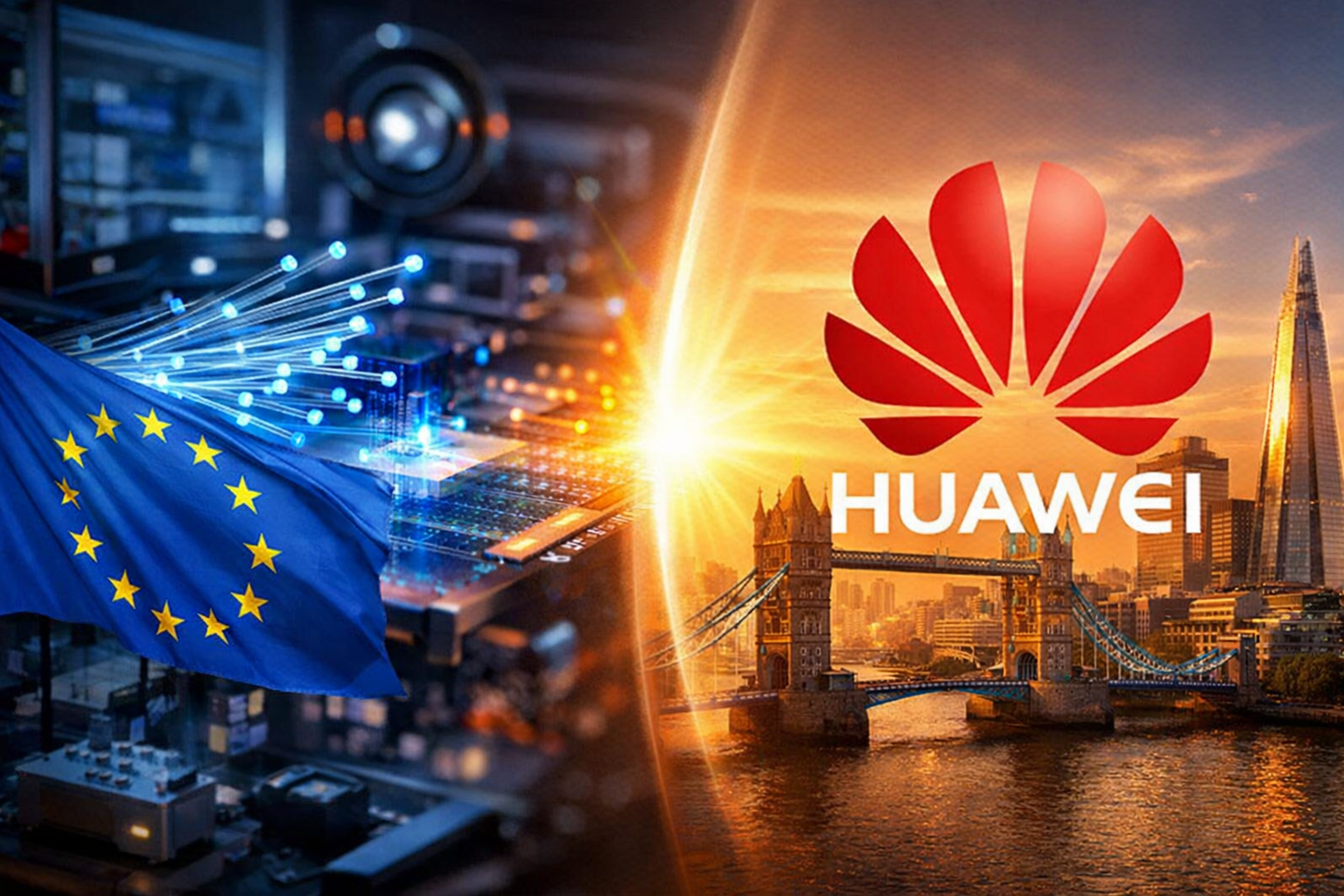
Image: Conceptual illustration of photonics infrastructure and geopolitical technology competition. AI-generated visual.
Footnote:
Update (13 February 2026, 22:35 CET): Industry sources clarified that Huawei’s Bragg Research Center originates from the former Centre for Integrated Photonics (CIP), originally a spin-off from British Telecom. The historical context has been incorporated into the article.
This article echoes the central argument of my book The Age of Light — Meaning, Machines and the Physics of Intelligence: that the next phase of global power will be shaped not by software alone, but by control over the physical infrastructure of intelligence — photonics, networks and energy.
Available via Amazon (Kindle Edition):
https://www.amazon.nl/dp/B0GMXLX56T
