Monday, April 20, 2026

Decisions are increasingly made by systems that cannot explain themselves. As performance improves, understanding fades. Between efficiency and accountability, a structural tension emerges—one that challenges how we define reasoning, responsibility and control in the age of AI.
Read More
Monday, April 20, 2026

Europe is not just building AI models. It is shaping a different philosophy of intelligence — one that balances speed with transparency and performance with control. Between Mistral and Aleph Alpha, a deeper question emerges: what kind of systems do we trust?
Read More
Thursday, April 16, 2026

As AI reshapes enterprise systems, Europe risks losing more than a company. It risks losing control over the logic that structures decisions—quietly shifting sovereignty from visible infrastructure to the invisible layer where economic behavior is defined.
Read More
Wednesday, April 15, 2026

As AI reshapes enterprise systems, Europe risks losing more than a company. It risks losing control over the logic that structures decisions—quietly shifting sovereignty from visible infrastructure to the invisible layer where economic behavior is defined.
Read More
Wednesday, April 15, 2026

As AI reshapes work, the disruption is not only structural but personal. Control becomes distant, understanding fades and professional identity shifts—leaving individuals navigating systems that still depend on them, yet no longer fully reflect their role or expertise.
Read More
Tuesday, April 14, 2026

Enterprise systems no longer just support organizations—they define how they operate. As SAP standardizes processes across Europe, a shared logic emerges, shaping decisions, limiting variation and quietly structuring the economic reality beneath visible strategy and control.
Read More
Tuesday, April 14, 2026

As AI absorbs routine work, the layer where expertise is formed begins to thin. What disappears is not just execution, but the path to judgment—leaving organizations efficient on the surface, yet increasingly detached from how and why decisions are made.
Read More
Monday, April 13, 2026
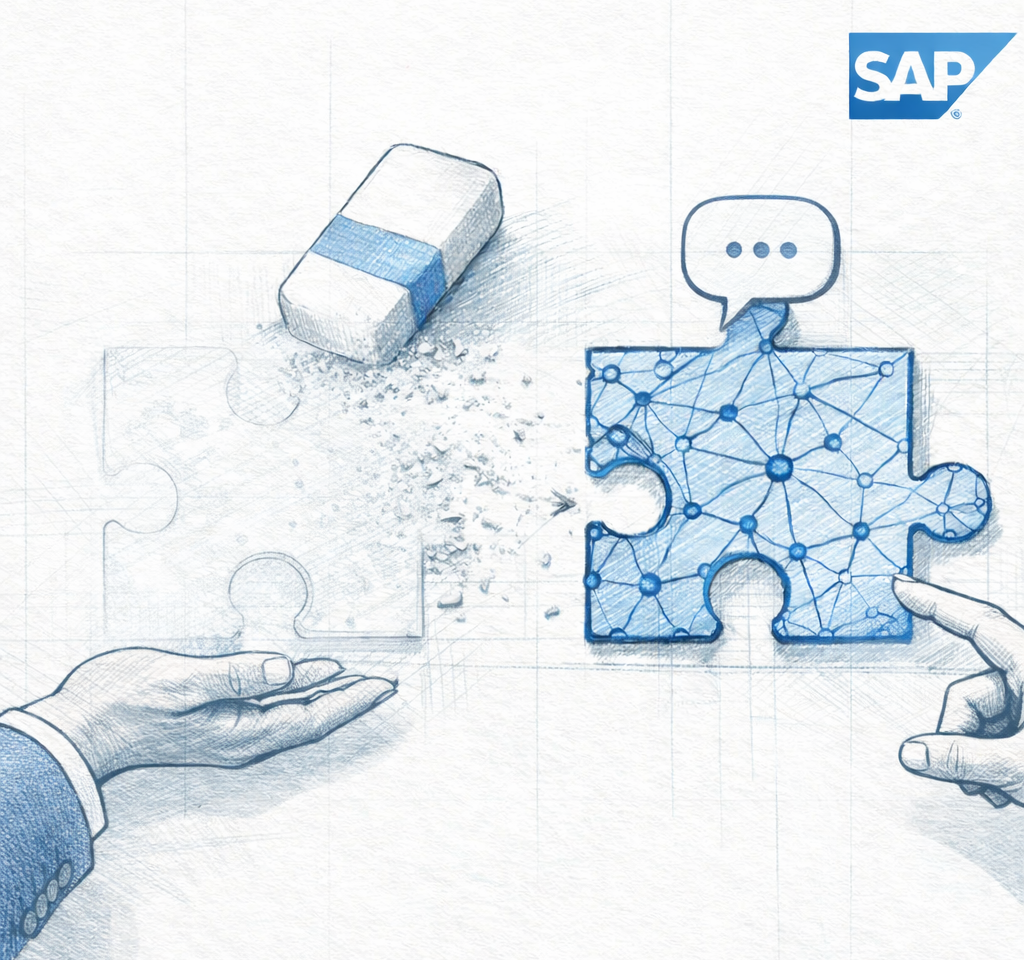
As interfaces disappear, interaction shifts from navigation to intent. What feels like simplicity masks a deeper change: processes become invisible, decisions harder to trace and control increasingly abstract within systems that now act on our behalf.
Read More
Sunday, April 12, 2026

The shift at SAP is not about fewer jobs, but different logic. As AI reshapes enterprise systems, work is no longer simply performed—it is structured, interpreted and increasingly defined by the systems themselves.
Read More
Thursday, April 9, 2026

Europe has built strong telecom infrastructure, but the cloud layer tells a different story. As control shifts toward compute, platforms and developers, the real question emerges: can Europe shape its digital system if its intelligence resides elsewhere?
Read More

 Available here: