Germany — Engineering Europe
Precision, Scale and Strategic Tension
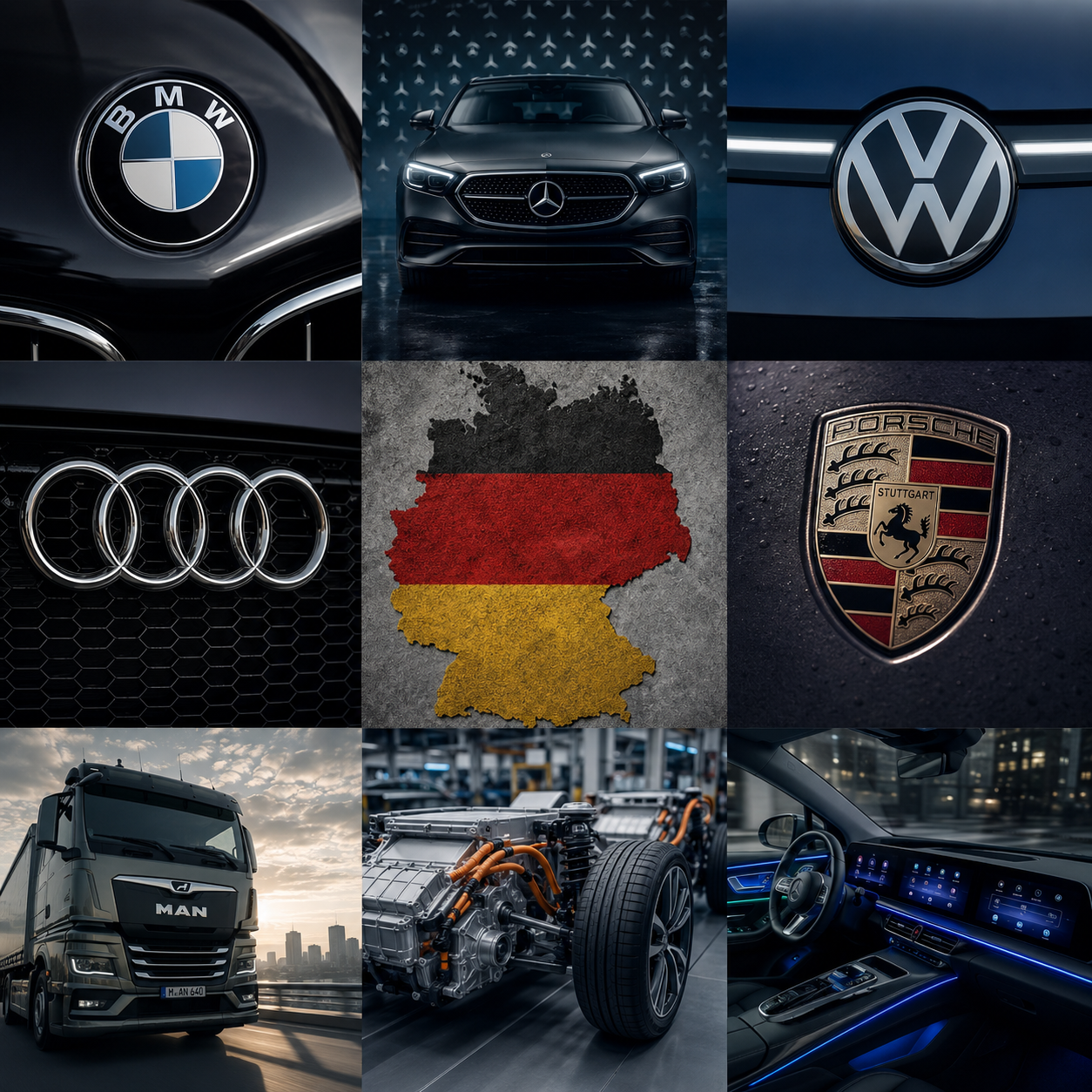
Germany remains Europe’s automotive powerhouse. BMW, Mercedes-Benz, Volkswagen, Audi, Porsche, MAN and Daimler Truck are not just brands; together they form one of the most sophisticated industrial ecosystems in the world.
For decades, Germany turned engineering precision into export power. Yet the industrial model that delivered decades of prosperity is increasingly challenged by electrification, software-defined mobility, Chinese competition, geopolitical fragmentation and structurally higher energy costs.
🟦 Can Germany Become Easy Again?
Germany’s strength was built on industrial complexity. Its supplier networks, vocational systems, engineering culture and regional clusters allowed the country to produce vehicles with extraordinary precision and reliability. But the same complexity now risks slowing adaptation. Electrification and software demand speed, simplification and shorter innovation cycles. Can Germany make its industrial system lighter without destroying the depth that made it powerful?
🟦 What Problem Is Germany Actually Trying To Solve?
The German automotive crisis is often described as a problem of electric vehicles. But that may be too narrow. The deeper issue is that value is moving away from mechanical engineering toward batteries, semiconductors, software and digital platforms. Germany can still build excellent cars. The more uncomfortable question is whether excellent cars still determine where value is created.
🟦 Caught Between Washington and Beijing
Germany is being squeezed between two industrial powers with very different advantages. China has scale, batteries, materials and an increasingly strong domestic automotive ecosystem. The United States dominates cloud infrastructure, AI platforms and much of the digital layer. Germany still manufactures at world-class level, but future mobility may be shaped by technologies it does not fully control. Can Europe speak about automotive sovereignty if the battery layer is Chinese and the software layer is American? If mobility becomes infrastructure, ownership increasingly matters.
🟦 Too Big To Fail?
Automotive is not just another German industry. It supports regions, suppliers, employment, exports and political stability. That makes transformation difficult, because every technological shift has social consequences. If Germany moves too slowly, the cost will not remain inside corporate balance sheets. It will reach workers, regions, governments and ultimately Europe’s wider industrial model. Is Germany’s automotive ecosystem becoming Europe’s largest industrial dilemma?
Signifier
Germany’s automotive challenge is not about selling fewer cars. It is about whether Europe’s most successful industrial ecosystem can remain relevant in an economy increasingly shaped by software, energy systems and geopolitical competition.
Brands
BMW • Mercedes-Benz • Volkswagen • Audi • Porsche • MAN • Daimler Truck
Keywords
Engineering • Export • Premium • Industry • Automation
This article is part of Rethinking Europe’s Automotive Future, a Signal series exploring how electrification, artificial intelligence, industrial policy and geopolitical competition are reshaping Europe’s mobility ecosystem.
Altair Strategic Forum
The Altair Strategic Forum explores Europe’s technological, industrial, financial and institutional transformation. As Europe develops new architectures for capital, innovation and long-term growth, the Forum aims to provide a space for dialogue, analysis and strategic reflection.
Professionals, researchers and organisations interested in following its development may register their interest and receive occasional updates.
Credit
Illustration by Altair Media Europe
Caption
Germany’s automotive ecosystem has long defined European industrial strength. Today, electrification, software, energy costs and geopolitical competition are forcing Europe’s engineering powerhouse to rethink its future.
