Who Sets the Terms for ASML in China?
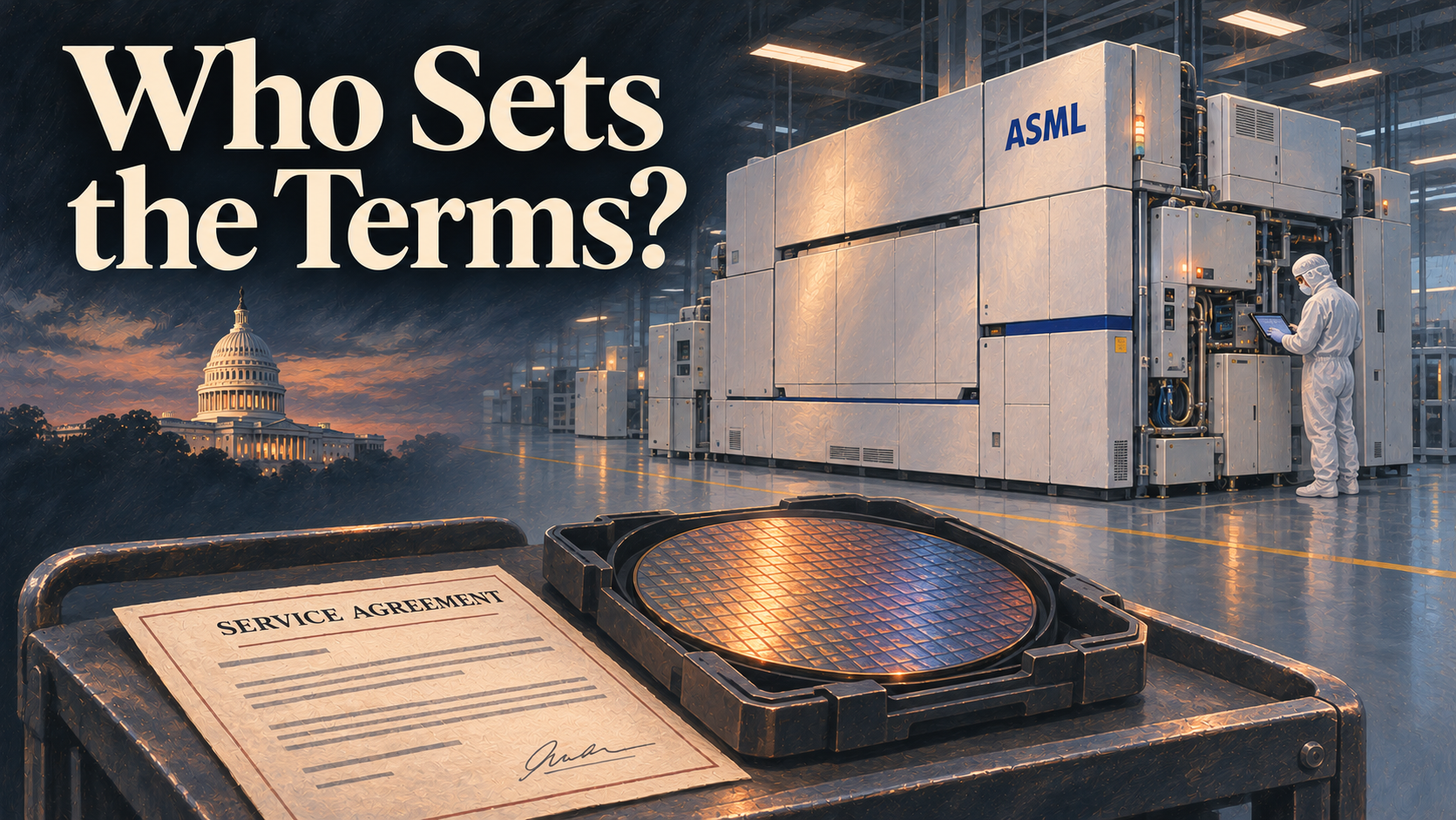
US lawmakers are targeting chipmaking tools and their maintenance.
Nvidia’s governance crisis is giving US lawmakers a fresh opening to tighten restrictions on China’s access to advanced chips. For ASML, the consequential proposal reaches further up the supply chain. The MATCH Act would press allies to restrict certain chipmaking equipment and servicing, exposing a European business to decisions negotiated in Washington and The Hague.
The pressure could follow an ASML system long after it leaves Veldhoven.
🟦 What connects Nvidia’s troubles to ASML?
Reuters put Nvidia’s two-session loss in market value at about $430 billion on 10 November. Lawmakers are using the Huang reports to press for controls on both access to advanced processors and the machinery used to make advanced chips. The MATCH Act predates the controversy. Its supporters are seeking to advance it alongside other chip measures through the National Defense Authorization Act, the annual US defence bill.
🟦 Which part of ASML’s business is exposed?
The Senate proposal expressly includes deep-ultraviolet immersion lithography equipment. It also seeks restrictions on servicing equipment at specified semiconductor manufacturing facilities in countries of concern, including China. ASML’s potential exposure spans future machine orders and support for systems already installed. The wording that survives negotiations will determine which customers, machines and activities are covered. The proposal still has to become law and be implemented.
🟦 What happens when a sold machine needs support?
The proposal’s definition of servicing reaches from repair and calibration to software updates and technical assistance. Restrictions could affect machine availability and factory output as repairs and scheduled maintenance become due. A customer may own the system while its production plans still depend on the support ASML is permitted to provide.
Customers in China accounted for 29.1% of ASML’s total net sales in 2025. In Q3 2026, the company reported €3.3 billion in worldwide service and field-option sales. The amount exposed to a new restriction depends on which installations and activities it covers.
🟦 Can The Hague keep control of its licences?
The Senate draft gives allies a period to align their controls with Washington’s. If diplomacy fails under the conditions it sets, the US would extend restrictions to covered allied equipment and servicing. Its definition of applicable items includes foreign-made products derived from specified US technology and products containing US components. In June, The Hague objected to that extraterritorial reach. For ASML, the pressure would travel through the technology and components in its systems as well as through diplomacy.
🟦 Could tighter controls help ASML’s future competitors?
ASML CFO Roger Dassen argued in October that restricting DUV sales would accelerate China’s development of competing technology. That is the company’s argument against the proposal. It also identifies a commercial risk beyond the next order. If Chinese factories invest more heavily in replacement tools and the engineers who support them, ASML could lose future service and upgrade business as well as machine sales. How quickly those suppliers can match ASML’s performance remains the practical test.
Signal
Watch whether the final US defence legislation includes MATCH provisions, and how it defines covered facilities and servicing. Those details will determine how much of ASML’s existing customer business faces a new licensing test.
This European Signal follows two reports on access to Nvidia’s chips and computing power.
🟥 Who Gets Nvidia’s Chips? — How much can Washington verify about where advanced chips end up and who uses them?
🟧 Who Sets the Terms for Southeast Asia’s AI Cloud? — Who verifies the customer when GPU time is resold across borders?
Credit
AI-generated illustration / Altair Media Europe
Caption
A service agreement and silicon wafer sit before an illustrated ASML installation. The US Capitol represents proposed American controls that could reach the company’s machine sales and servicing in China.
