
Euronext has connected Europe’s exchanges across borders. Now comes the harder challenge: can European capital markets help turn the continent’s vast savings into the long-term investment needed for technology, energy, defence and industrial renewal?
Who Runs Europe’s Capital Markets?
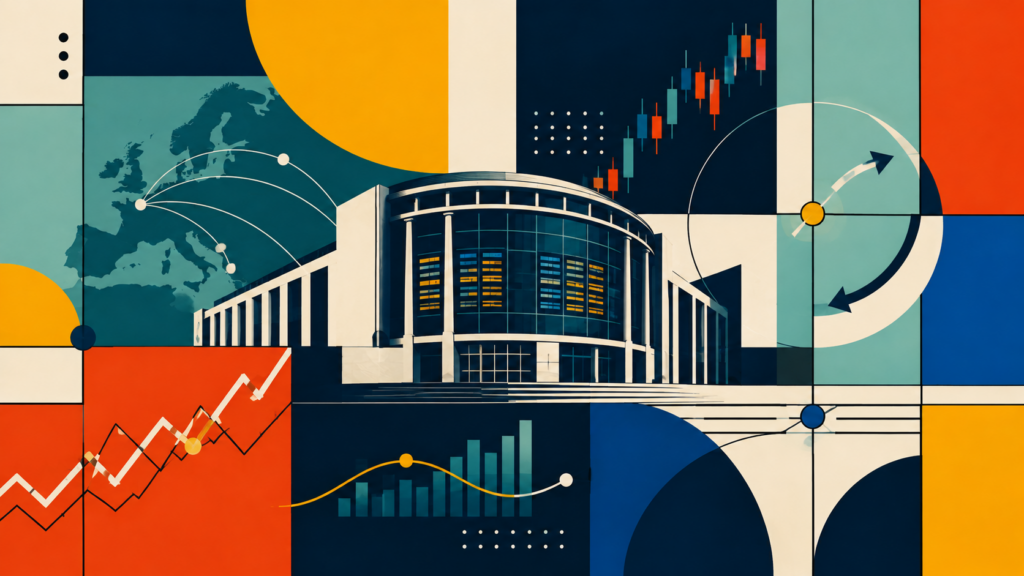
The exchanges, infrastructure providers and data platforms shaping how European capital moves.
Europe’s capital markets are not simply places where securities are bought and sold. They depend on a network of exchanges, clearing systems, settlement infrastructure, data platforms and technology providers that increasingly determine how capital is raised, priced, routed and understood. This series examines the companies operating those systems — and the power that comes with running them.

Deutsche Börse is far more than a place where securities are traded. As trading, clearing, settlement, custody, data and technology converge, a deeper question emerges: when does a commercial exchange become infrastructure that Europe’s financial system depends upon?

London Stock Exchange Group is becoming much more than an exchange. As data, indices, cloud technology and artificial intelligence increasingly shape financial decisions, a new question emerges: who controls the information through which global capital decides where to go?

Northern Europe consists largely of small economies, yet its public markets have produced an unusually connected ecosystem for growing companies. Nasdaq Nordic & Baltic raises a bigger European question: can accessible capital markets help small countries build globally competitive companies?

SIX Group raises an unusual question about modern financial markets. When banks and financial institutions collectively own infrastructure they also depend upon, ownership becomes more than a corporate matter — it becomes a question of governance, resilience and economic responsibility.

Warsaw Stock Exchange helped Poland transition towards a market economy. Three decades later, it faces a different challenge: can Warsaw connect the growing companies and industries of Central and Eastern Europe with the deeper pools of capital available across Europe?

Luxembourg Stock Exchange shows how the role of an exchange can extend beyond raising capital. Through sustainable finance, it raises a deeper question for Europe: can financial markets make clearer not only where money goes, but what it is for?
About the series
Who Runs Europe’s Capital Markets? examines the institutions and companies that operate the infrastructure through which European capital moves.
Each article focuses on a different model of market organisation. Euronext explores whether a cross-border exchange can help turn Europe’s savings into productive investment. Deutsche Börse raises the question of how much trading, clearing, settlement, custody, data and technology one company should operate. LSEG shows what happens when an exchange evolves into a global data and information business.
Nasdaq Nordic & Baltic offers another perspective: whether relatively small economies can use accessible public markets to build globally competitive companies. SIX Group brings ownership and governance into focus, while Warsaw Stock Exchange shows how market infrastructure can help shape the economic development of an entire region. Luxembourg Stock Exchange, meanwhile, asks a broader question about the purpose of capital itself.
Taken together, these organisations reveal that modern exchanges are no longer merely trading venues. They are becoming financial infrastructure companies — combining markets, data, technology, post-trade services and increasingly strategic influence over how capital is organised.
The series asks not only who operates Europe’s capital markets, but how these operators shape access, scale, transparency, resilience and the direction of investment across the European economy.
Credit
Image: Altair Media
Caption
Europe’s capital markets are built on an increasingly complex infrastructure of exchanges, data platforms, trading systems and post-trade services. Who Runs Europe’s Capital Markets? explores the operators behind that architecture — and how their systems influence the way capital is raised, priced, connected and deployed across Europe.
