
London Stock Exchange Group is becoming much more than an exchange. As data, indices, cloud technology and artificial intelligence increasingly shape financial decisions, a new question emerges: who controls the information through which global capital decides where to go?
Who Governs European Finance
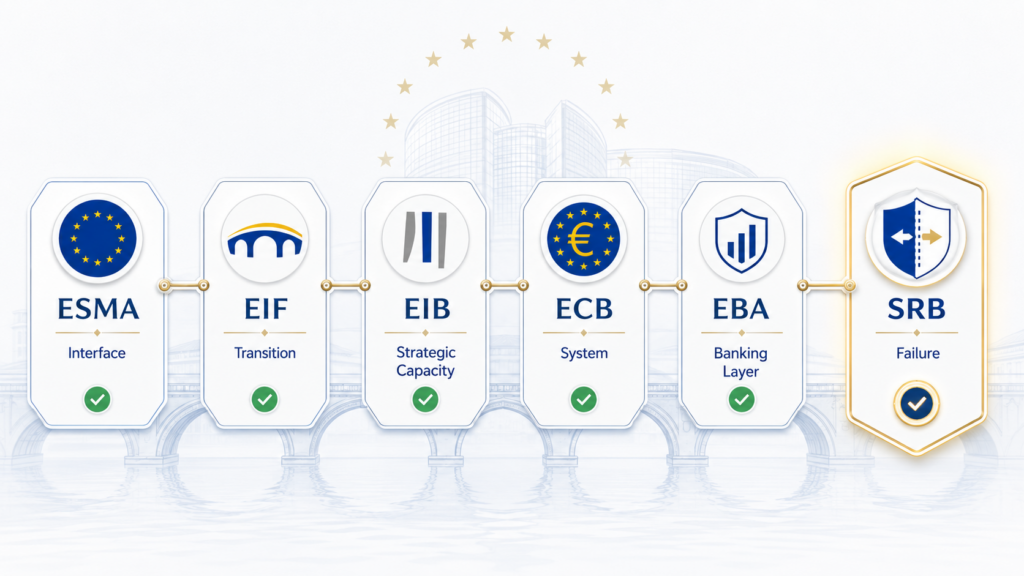
The institutions behind Europe’s financial architecture — and the different layers of power they govern.
Europe’s financial system is not governed by a single institution. It rests on a network of public bodies that supervise markets, support investment, safeguard banks, maintain monetary stability and manage failure. This series examines how those institutions divide responsibility — and how together they shape the financial architecture on which Europe’s economic ambitions depend.

As Europe’s capital markets become more connected, supervision remains largely national. ESMA is emerging as the institution best placed to guard that interface — protecting market integrity without becoming the operator or owner of the system.

The European Investment Fund rarely chooses individual winners. Its deeper role is to share risk, anchor investment vehicles and strengthen the transition from innovation to investability — helping private capital move where markets are not yet ready to move alone.

Europe’s public bank is becoming more than a lender. As strategic risks grow, the EIB increasingly helps determine which infrastructure, technologies and industrial capacities can become financeable — turning public financial capacity into part of Europe’s industrial architecture.

Europe’s capital markets do not operate independently. Beneath every share, bond and investment fund lies a monetary system that prices risk, provides liquidity and settles transactions. The ECB guards the stability on which this emerging market architecture rests.

Europe wants deeper capital markets, but its banking layer remains indispensable. The EBA’s role is to keep that layer coherent across the Single Market — strong enough to absorb shocks, flexible enough to support growth, and connected enough to work with capital markets.

A serious financial architecture cannot be built on the assumption that institutions never fail. The Single Resolution Board exists to make bank failure manageable — preserving critical functions while ensuring that shareholders, creditors and institutions themselves can still bear the consequences.
About the series
Who Governs European Finance maps the institutions that make Europe’s financial system work.
Each article focuses on a different layer of that architecture. ESMA guards the interface between increasingly integrated capital markets and predominantly national supervision. The EIF helps bridge the gap between innovation and investability, while the EIB increasingly deploys its balance sheet as part of Europe’s strategic and industrial capacity.
Beneath those investment and market layers sits the ECB, maintaining the monetary and liquidity foundations on which financial activity depends. The EBA helps preserve coherence and resilience across Europe’s banking system. And when institutions can no longer be preserved, the SRB provides the architecture for orderly failure.
Taken together, these organisations reveal something larger than their individual mandates. European finance is governed through a distributed institutional system in which supervision, capital allocation, monetary stability, banking resilience and resolution interact.
The series asks not simply what each institution does, but where its authority begins, where it ends, and how the different layers of European financial governance fit together.
Credit
Image: Altair Media
Caption
Europe’s financial architecture is built from interconnected layers of supervision, investment, monetary stability, banking resilience and resolution. Who Governs European Finance examines the institutions responsible for governing those layers — and how their mandates combine to shape the European financial system.
